
☰ All tutorials
Start here
Tool tutorialsHow to trade with ChartMineStocks
Stock monitorMy watchlistStock scores & checklistMarket & sectors
Nifty 50Bank NiftySensexFin NiftyDaily market reportMarket breadthSector rotationSector heatmapStock screenerRelative strength (RS)MCX commodity pricesFear & Greed IndexWhat happens after…Scanners
Top gainers & losersStocks to watch tomorrowNR7 stocks scannerInside bar stocks52-week high stocksGap up & gap down stocksRSI oversold stocksGolden cross stocksSuperTrend buy stocksScan builderEMA 9/21 crossoverMACD crossoverADX strong trendBollinger breakout / squeezeVolume spike stocksOpen = high / open = lowCandlestick pattern scannerNarrow CPR scannerF&O data
F&O ban listOI build-upOption chainPCR & max painExpiry calendarF&O lot sizesOI build-up heatmapPCR trendMax pain trendFutures basisStock screens
Quarterly growersProfit growth stocksLow P/E stocksMutual fund buyingNear 52-week low, growingDebt-free companiesHigh ROE & ROCEMagic Formula stocksLow price-to-bookSmart money
FII / DII dataShareholding changesBig-money footprintShort selling dataF&O positions by participantBulk & block dealsPromoter buyingDelivery percentageCalendars
Results calendarQuarterly results trackerBoard meetingsCorporate actionsIPO calendarIPO performanceResearch & planning
Strategy testerCompare stocksDividend yield stocksASM / GSM listExpiry-day movesSeasonality & stock historyNSE holidays 2026Position size calculatorOption payoff calculatorPivot point calculatorMore
Stock scanners hubStock screensHow to use the Promoter buying page
A plain-language guide to promoter trade disclosures: who files, what SEBI’s insider-trading (PIT) and takeover (SAST) rules require, how to read every part of the page, and what the filings did and did not predict in our data.
What the promoter buying page shows, in plain words
The promoters of a company are the people or group that control it: the founding family, the parent company, their relatives and the firms they own. Nobody knows the business better. So when a promoter spends their own money buying more shares in the market, many investors take notice. When they sell, people notice too.
In India, promoters must tell the stock exchanges when they trade their company’s shares. The Promoter buying page collects these disclosures from NSE and shows them in one table: who bought or sold, how many shares, the ₹ value, what % of the company, how (open market, allotment, transfer, gift, block deal) and what they hold afterwards, with a link to the original filing.
Since 11 Nov 2026 the page has two sources:
- Insider-trading disclosures (SEBI PIT, Regulation 7(2)): filed by promoters and promoter-group members for trades above ₹10 lakh in a quarter. These are the new filings you see every evening. They usually include the deal value in ₹.
- SAST Regulation 29 disclosures: filed by promoters and other large holders (5% or more) for big changes in holding. NSE stopped publishing this list after 3 Nov 2026, so the page keeps the SAST filings from 28 Sep to 3 Nov 2026 as history, and no new ones are added.
One line to remember: a promoter filing tells you what an insider did, usually a day or two later. It does not tell you why, and in our data it did not reliably predict the price.
Who files: promoters, large holders and insiders
Several groups of people own and trade a listed company’s shares. Knowing who is who helps you read each filing.
| Who | Who they are | What they must disclose |
|---|---|---|
| Promoters and promoter group | The controlling family or company and everyone linked to them: spouses, children, family trusts, group companies. Filings say “Promoter” next to them on the page. | Insider-trading (PIT) disclosures for trades above ₹10 lakh in a quarter; SAST disclosures for large changes; pledges of their shares. |
| Large shareholders (5% or more) | Anyone else, often a fund or an investment company, that owns 5% or more. | SAST disclosure on crossing 5% and on every change of more than 2% after that. These appear on the page only up to 3 Nov 2026. |
| FIIs / FPIs and DIIs | Foreign portfolio investors, and Indian institutions such as mutual funds, insurers and banks. | Like anyone else, a SAST filing only if they hold 5%+. |
| Directors, employees (“designated persons”) | People with access to unpublished information. | PIT disclosures too, but the page shows only promoter and promoter-group PIT filings. |
| Public / retail | Ordinary investors. | Nothing, unless they reach 5%. |
PIT filings name the filer’s category: Promoter, Promoter Group, Promoter and Director or Promoter Immediate Relative. On 12 Nov 2026 the page held 309 PIT rows, all from these four categories. Everyone’s holding also appears, as a total for each group, in the quarterly shareholding pattern; see the shareholding changes tutorial.
The rules in plain words: SEBI PIT, SAST and creeping acquisition
SEBI PIT Regulation 7(2): the insider-trading disclosure (the page’s main source now)
- Who: promoters, promoter-group members, directors and designated employees.
- When: once their trades in a calendar quarter add up to more than ₹10 lakh in value (one trade or several).
- Deadline: two trading days to tell the company, and the company tells the exchanges within two trading days.
- Other limits: insiders cannot trade while the trading window is closed (usually from the quarter end until 48 hours after results), and designated persons must not do an opposite trade within six months.
Because the deadline is short, PIT filings arrive fast. In the 309 PIT rows on the page on 12 Nov 2026, the median gap between the last day of the trade and the filing date was 1 day, and 249 of them came within 3 days.
SAST Regulation 29: the large-holding disclosure (history up to 3 Nov 2026)
- Crossing 5%. Anyone whose holding (together with “persons acting in concert”, or PACs, meaning people acting together with them) reaches 5% or more must disclose it.
- Every change of more than 2%. Anyone already holding 5% or more must disclose each change of more than 2% since their last disclosure, up or down.
- Deadline: within two working days. In practice, the SAST rows on the page appeared on NSE a median 12 days after the deal.
Acquisition and disposal
Acquisition means the filer’s shares went up: bought on the exchange (“Market Purchase” in PIT, “Open Market” in SAST), received an allotment, converted warrants, or received shares as a gift or transfer. Disposal (shown as “Sold”) means their shares went down: “Market Sale”, a block deal, an off-market sale, a gift or a transfer.
Open offers and creeping acquisition
- Anyone whose holding reaches 25% must make an open offer to buy at least 26% more from the public at a fair price.
- Creeping acquisition: someone who already holds 25% or more (but less than the 75% maximum) may add up to 5% per financial year without an open offer.
- Inter-se transfers (shares moving between members of the promoter group) are exempt from the open offer, subject to conditions. They change who in the family holds the shares, not how much the family owns.
Why promoter buying is watched: advantages and limits
✅ Insiders’ own money
Open-market buying means a promoter paid the market price from their own pocket. Many investors read that as confidence in the business.
✅ Fast and in rupees
PIT filings usually arrive within a day or two and state the ₹ value, so you can see at once whether a deal is ₹10 lakh or ₹200 crore.
✅ Official, linked source
Every row links to the filing on NSE, so you can check the exact details.
✅ Warning signs too
Repeated promoter selling, or a promoter cutting a big part of their holding, is worth knowing about if you own the stock.
The limits (please read this part)
- Not all “acquisitions” are buying. Allotments, warrant conversions, inter-se transfers and gifts all show as acquisitions. Only Market Purchase / Open Market means the promoter bought on the exchange.
- One person is not the group. PIT filings are made person by person. One family member buying while others sell is common (case 2).
- The same deal can appear twice. Until 3 Nov 2026 a big promoter deal often produced a PIT filing for each person and a SAST filing for the group total, days apart (case 1). The page folds re-filings within one source, not across the two sources.
- Still a little late. Even a 1-day delay means the price may have moved before you see the filing (case 3).
- Gaps. In 18 rows the share count is missing in NSE’s data; the page shows “—” with “not stated in filing”, so open the filing for those.
Did it work? What our data says
We checked the page’s own history. Taking each stock’s first promoter open-market purchase in the PIT filings dated 28 Sep to 28 Oct 2026 (43 stocks with 10 sessions of prices after the filing), and buying at the close on the filing day:
| After 10 trading sessions | Result |
|---|---|
| Stocks that rose | 19 of 43 |
| Stocks that beat the median NSE stock over the same days | 21 of 43 |
| Median return compared with the median stock | −0.7 points |
That is close to a coin toss. An earlier check on the SAST filings (13 stocks, October 2026) gave a similar answer: 5 of 13 beat the median stock. A longer test using the quarterly shareholding pattern (three quarters of 2026) found a small tilt in favour of stocks where the promoter stake rose by 0.5 pts or more, on small samples. None of this is a reliable signal.
So how should you use it? As a research lead. Ask: did the promoter buy on the open market, how much in ₹ and as % of their holding, is it repeated, what did the rest of the family do, and does the business justify it? Then manage the risk like any other idea.
A tour of the page
Open Promoter buying. Under the title, a Latest filings box sums up the last 30 days. Below it are four tabs with counts, the filters, and the table of filings, newest first.
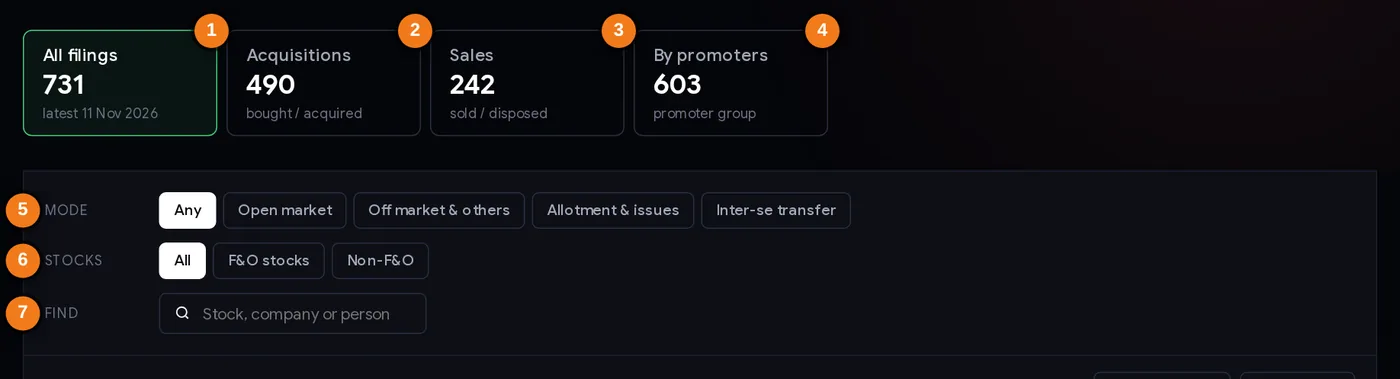
- 1All filings on the page, with the latest filing date
- 2Acquisitions (holding went up)
- 3Sales (holding went down)
- 4Promoter and promoter-group filings
- 5Mode: open market, off market & others, allotment & issues, inter-se transfer
- 6All stocks, F&O only or non-F&O
- 7Find a stock, company or person
Tabs and filters
- All filings: everything on the page, with the date of the latest filing (731 rows, latest 11 Nov 2026, when checked on 12 Nov 2026).
- Acquisitions: rows where the filer’s holding went up (490).
- Sales: rows where it went down (242). A rare row that reports both appears in both tabs.
- By promoters: only promoter and promoter-group filings (603). Every PIT row counts here; the rest are older SAST rows filed by promoters.
- Mode: Any, Open market (Market Purchase, Market Sale and SAST’s Open Market), Off market & others (off-market deals, gifts, block deals, pledge invocations and anything NSE labels “Others”), Allotment & issues (allotments, preferential offers, conversions, public and rights issues) and Inter-se transfer. On 12 Nov 2026 they held 446, 159, 53 and 73 rows. Note that a promoter’s block deal sale falls under Off market & others, even though it happens on the exchange.
- Stocks: all, F&O stocks only, or non-F&O.
- Find: a stock, company or person’s name. Download CSV saves the filtered list, including cat (Promoter, Promoter Group…), val (₹ value), side, acq_sh, sale_sh and refiled; Reset filters clears everything.
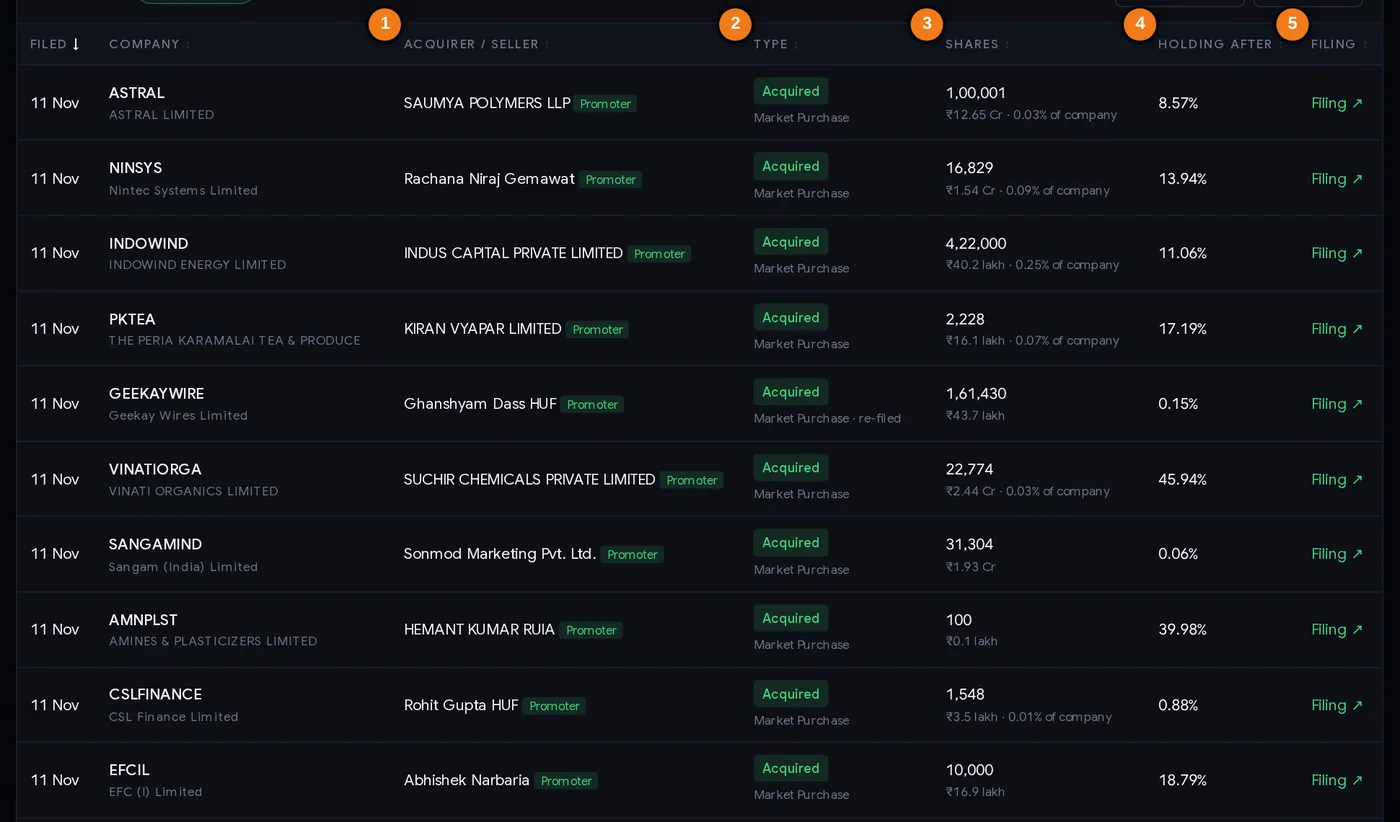
- 1Who filed; green tag = promoter group
- 2Acquired or sold, with the mode
- 3Shares, ₹ value and % of the company
- 4Filer’s holding after the deal
- 5Link to the original NSE filing
Every column explained
| Column | What it tells you |
|---|---|
| Filed | When the disclosure appeared on NSE. The trade happened earlier; the filing shows the dates. |
| Company | Symbol and company name. |
| Acquirer / seller | The person or company that filed. A green “Promoter” tag marks promoter-group members. “Along with PAC” (SAST only) means together with persons acting in concert. |
| Type | Green “Acquired” or red “Sold”, with the mode underneath as NSE states it: Market Purchase, Market Sale, Open Market, Block Deal, Gift, Inter-se transfer, Preferential Offer, or “Off market / other” for NSE’s “Others”. An amber “Bought & sold” tag appears only when one row fills both sides (rare). “· re-filed” after the mode means the same disclosure was filed more than once and only the latest is shown. |
| Shares | Number of shares, and underneath the ₹ value (in lakh or crore, from the filing; PIT rows only) and the % of the company. “—” with “not stated in filing” means NSE’s data has no share count. |
| Holding after | The filer’s own holding (% of the company) after the deal. For a promoter this is usually that one person or entity, not the whole group. |
| Filing | Link to the original document on NSE. |
Step by step: a 10-minute weekly routine
- Open the page and click “By promoters”. Then choose Open market in Mode. This leaves only promoters who traded on the exchange.
- Look at the ₹ value first. The small line under the share count gives it. A ₹15 lakh trade and a ₹200 crore trade are different stories. Skip tiny ones unless you follow the stock closely.
- Search the stock name. Type it in Find to see every filing for that company: other family members, the same deal in SAST form, gifts, block deals. Sales by relatives can cancel out one person’s purchase.
- Look for repeats. Several purchases by the same promoter over weeks say more than one. Re-filings of the same disclosure are already folded into one row marked “· re-filed”.
- Check the whole group. Open the stock page and look at the promoter holding over time; compare with the shareholding changes page after the quarter.
- Look at the other side. Who sold to them? A fund exiting (in bulk and block deals) can explain the promoter’s purchase.
- Check events. Results dates (board meetings), open offers, buybacks, allotments.
- Write down your view and your exit point before acting on anything.
Three playbooks
Playbook A: the conviction filter (investing)
Keep only promoter open-market purchases that are meaningful: a clear rupee amount (for example ₹1 crore or more) or at least about 0.1% of the company, preferably repeated, with no family members selling at the same time. Then check the business (results growth, debt) and valuation. Treat a pass as “worth researching”, not as a buy call.
Playbook B: the warning light (if you already own it)
Search for your stocks every week. Repeated promoter sales on the open market or through block deals, or a promoter cutting a large % of their own holding, are reasons to re-read the latest results and announcements. Some sales have harmless reasons (meeting the 25% public-holding rule, family needs, tax), so find out before reacting.
Playbook C: follow the control changes
Filings near 25%, or under Off market & others, Allotment & issues or Inter-se transfer, can be the first sign of a takeover, an open offer, a family settlement or a group restructuring. These events are complex; read the company’s announcements in full.
Position size first. Decide how much of your capital you could lose if you are wrong (for example 1% for a long-term idea), and use the position size calculator. Promoters can be wrong too, and they usually hold for years, not weeks.
Case studies from the Sep–Nov 2026 filings
Five real filings from the page, with what happened afterwards. NSE closing prices in ₹.
1. Electrosteel Castings: one deal, two sources, and the price still fell
On 1 Oct 2026, seven promoter-family members and companies (Mayank Kejriwal, Asha Kejriwal, Wilcox Merchants, Tulsi Highrise and others) filed PIT disclosures for market purchases on 28–29 Sep: about 2.71 crore shares worth about ₹195 crore in total, the largest single row being Mayank Kejriwal’s 83,97,600 shares (1.36%, ₹59.98 crore). Two weeks later, on 15 Oct, the SAST filing for the whole group arrived: Wilcox Merchants with persons acting in concert acquired 3.09 crore shares (5.0%), holding after 54.53%. Same deal, two sources, fourteen days apart. The stock closed ₹74.54 on 1 Oct and ₹71.73 on 11 Nov 2026 (−3.8%). Lessons: do not count the PIT rows and the SAST row as separate buying; and large promoter buying did not stop the price slipping.
2. Kajaria Ceramics: one promoter bought, the family sold more
The SAST list showed promoter Rishi Kajaria buying 1.80 lakh shares (0.11%) on 29–30 Sep (filed 12 Oct, re-filed 15 Oct). But on 1 Oct, PIT filings from four promoter-group members, including two family trusts, showed market sales on the same days: CK Trustees 23 lakh shares (1.46%, ₹276.29 crore), RK Trustees 10 lakh shares (0.64%, ₹124.60 crore), Shikha Kajaria 6 lakh shares and Vedant Kajaria 1 lakh shares. That is why the quarterly pattern showed promoter-group holding falling from 47.69% to 46.74%. The stock closed ₹1,225.10 on 1 Oct and ₹1,187.50 on 11 Nov (−3.1%). Lesson: search the stock name and read every family filing before calling it “promoter buying”.
3. Havells India: a large purchase, and the move came first
Filed 11 Nov 2026: promoter QRG Investments and Holdings bought 21,00,000 shares (0.34%) in market purchases on 6–9 Nov, worth ₹233.20 crore; holding after 41.54%. The stock had closed ₹1,068.10 on 5 Nov, before the buying started, and ₹1,159.50 on 9 Nov, the last day of the buying (+8.6%), all before the filing was public. It closed ₹1,174.10 on the filing day. Lesson: even with a 2-day delay, much of a move can happen before you see the filing. It is too early to say what followed.
4. Lotus Developers and Gallantt Ispat: two kinds of promoter selling
Filed 5 Nov: promoter Anand Kamalnayan Pandit sold 2,38,58,955 shares (4.89%) of Lotus Developers in market sales on 3–4 Nov, worth ₹572.96 crore; holding after 65.14%. The stock closed ₹234.20 on the filing day and ₹224.72 on 11 Nov (−4.0%). Filed 4 Nov: promoter and director Dinesh R. Agarwal sold 50,00,000 Gallantt Ispat shares (2.08%, ₹250.50 crore) by block deal on 3 Nov, after a smaller market sale filed the day before. That row sits under Off market & others, so a filter set to Open market would miss it. Lessons: look at the size and the mode; and a sale is a reason to read the company’s announcements, not proof that the price will fall.
5. TCI Express: “Both” filings and inter-se transfers
Filed 12 Oct (SAST): several promoter entities reported shares moving among themselves on 29–30 Sep. The page shows each party as its own row: XPS Cargo Services acquired 10.90 lakh shares (2.84%) on the open market while TCI Trading sold the same 10.90 lakh, and Dharmpal Agarwal acquired 1.23 lakh shares (0.32%) by inter-se transfer. The promoter group’s total barely moved: 69.46% to 69.42%. Lesson: shares moving inside the family are not new buying.
Common mistakes
- Counting every “acquisition” as buying. Allotments, transfers and gifts are not market purchases. Filter to Open market.
- Ignoring the ₹ value. A ₹12 lakh trade is noise for a large company.
- Counting the same deal twice. Until 3 Nov 2026 one deal could appear as several PIT rows (one per person) and one SAST row (the group total), as in case 1. Same family, same dates = one deal.
- Reading one person as the family. In case 2, one promoter bought ₹21–22 crore while relatives sold over ₹480 crore.
- Missing block deals. A promoter’s block-deal sale sits under Off market & others (case 4).
- Treating “holding after” as the group’s holding. It is usually just the filer’s own holding.
- Buying because a promoter bought, with no stop. In our check, fewer than half of 43 promoter-bought stocks beat the median stock over the next 10 sessions.
- Panicking on every sale. Find the reason first.
Checklist before you act on a promoter filing
- The filer is a promoter (green tag) and the mode is Market Purchase / Open Market.
- The deal is meaningful in ₹ and in % of the company.
- Other family members did not sell at the same time (search the stock name).
- It is a new deal, not a re-filing, the SAST version of a PIT deal, or the other half of a transfer inside the group.
- No allotment, open offer, buyback or results day explains it.
- The group’s total holding is moving the same way (stock page, next shareholding pattern).
- The business and valuation support the idea on their own.
- Position size and exit point are decided before you act.
Glossary
| Promoter | The person or group in control of a company, with relatives and group companies (the promoter group). |
| SEBI PIT | Prohibition of Insider Trading Regulations, 2015. Regulation 7(2) makes promoters, directors and designated persons disclose trades above ₹10 lakh in a quarter within two trading days. |
| SAST | SEBI (Substantial Acquisition of Shares and Takeovers) Regulations, 2011: the takeover and large-holding rules. Regulation 29 is the 5% / 2% disclosure rule. |
| Market Purchase / Market Sale | A PIT filing’s words for buying or selling on the exchange (SAST says “Open Market”). |
| Block deal | A large trade done in the exchange’s special block-deal window, usually between two big parties. |
| PAC | Persons acting in concert: people or companies acting together; their holdings are counted together. |
| Open offer | An offer to buy at least 26% of the shares from the public, required when someone reaches 25% or crosses the creeping limit. |
| Creeping acquisition | A holder with 25% to 75% may add up to 5% per financial year without an open offer. |
| Inter-se transfer | Shares moving between members of the promoter group. |
| Re-filing | The same disclosure filed again, often to correct it; the page shows only the latest and marks it “re-filed”. |
| Preferential allotment | New shares issued by the company to chosen investors at a set price. |
| Trading window | The period when insiders may trade; it closes around results. |
Questions
Where can I see promoter buying in Indian stocks today?
ChartMine’s Promoter buying page lists the latest promoter and promoter-group trade disclosures on NSE, newest first, with the ₹ value. Click ‘By promoters’ and set Mode to ‘Open market’ to see promoters who bought or sold on the exchange.
Is promoter buying a good sign for a stock?
Open-market buying with the promoter’s own money is often read as confidence, but it is not a reliable price signal. In ChartMine’s check of Sep–Oct 2026 filings, 21 of 43 promoter-bought stocks beat the median stock over the next 10 sessions. Check the size, the family’s other trades and the business.
What is SEBI PIT Regulation 7(2)?
The insider-trading rule that makes promoters, promoter-group members, directors and designated employees disclose their trades once they exceed ₹10 lakh in a calendar quarter. They tell the company within two trading days, and the company tells the exchanges within two trading days.
What is SAST Regulation 29?
The part of SEBI’s takeover rules that requires anyone reaching 5% of a company, and anyone above 5% whose holding changes by more than 2%, to disclose it within two working days. NSE stopped publishing its SAST Regulation 29 list after 3 November 2026, so ChartMine keeps those filings as history.
What is the difference between Market Purchase and Open Market?
Both mean shares bought on the exchange. Insider-trading (PIT) filings say Market Purchase or Market Sale; SAST filings say Open Market. ChartMine’s Open market filter includes both.
What is creeping acquisition?
A shareholder who already owns 25% or more, but below the 75% maximum, may increase their holding by up to 5% in a financial year without making an open offer to the public. Buying more than that triggers an open offer.
What is an inter-se transfer between promoters?
A transfer of shares between members of the promoter group, such as between family members or group companies. It changes who holds the shares inside the group, not the group’s total holding.
Why does a filing say “re-filed” or show “not stated in filing”?
“Re-filed” means the company filed the same disclosure more than once; ChartMine keeps only the latest so the deal is not counted twice. “Not stated in filing” means NSE’s data has no share count for that row; open the original filing for the details.