
☰ All tutorials
Start here
Tool tutorialsHow to trade with ChartMineStocks
Stock monitorMy watchlistStock scores & checklistMarket & sectors
Nifty 50Bank NiftySensexFin NiftyDaily market reportMarket breadthSector rotationSector heatmapStock screenerRelative strength (RS)MCX commodity pricesFear & Greed IndexWhat happens after…Scanners
Top gainers & losersStocks to watch tomorrowNR7 stocks scannerInside bar stocks52-week high stocksGap up & gap down stocksRSI oversold stocksGolden cross stocksSuperTrend buy stocksScan builderEMA 9/21 crossoverMACD crossoverADX strong trendBollinger breakout / squeezeVolume spike stocksOpen = high / open = lowCandlestick pattern scannerNarrow CPR scannerF&O data
F&O ban listOI build-upOption chainPCR & max painExpiry calendarF&O lot sizesOI build-up heatmapPCR trendMax pain trendFutures basisStock screens
Quarterly growersProfit growth stocksLow P/E stocksMutual fund buyingNear 52-week low, growingDebt-free companiesHigh ROE & ROCEMagic Formula stocksLow price-to-bookSmart money
FII / DII dataShareholding changesBig-money footprintShort selling dataF&O positions by participantBulk & block dealsPromoter buyingDelivery percentageCalendars
Results calendarQuarterly results trackerBoard meetingsCorporate actionsIPO calendarIPO performanceResearch & planning
Strategy testerCompare stocksDividend yield stocksASM / GSM listExpiry-day movesSeasonality & stock historyNSE holidays 2026Position size calculatorOption payoff calculatorPivot point calculatorMore
Stock scanners hubStock screensHow to use the Bulk & block deals page
A plain-language guide to NSE bulk and block deals: what they are, who the buyers and sellers usually are, why their names matter more than the size, how to read every part of the page, and five real case studies from late 2026.
Bulk and block deals, in plain words
Most days you only see the price and the volume of a stock. You do not see who traded it. Bulk and block deals are the exception: when someone trades a very large quantity, the exchange publishes the name of the buyer or seller, the number of shares and the price, the same evening.
- Bulk deal: one client (a fund, a company, a person) buys or sells more than 0.5% of a company’s listed shares in a single day. It can be one big trade or many small ones added together, done in the normal market. The broker reports it and NSE publishes it after the close.
- Block deal: one single large trade done in a separate, short block-deal window (since December 2025, 8:45 to 9:00 AM and 2:05 to 2:20 PM), apart from the normal order book. The price must be within 3% of a reference price: the previous day’s close in the morning window, and the average price of trades between 1:45 and 2:00 PM in the afternoon window. The minimum order is ₹25 crore: SEBI raised it from ₹10 crore by a circular of 8 Oct 2025, in force from December 2025 (older articles still say ₹10 crore). One order can be filled against several buyers or sellers, so a single row in the list can be smaller than ₹25 crore. Every block trade must end in delivery; it cannot be squared off the same day. Block trades are almost always arranged in advance: the buyer and seller (usually through their brokers) agree on the quantity and price, then put the trade through the window.
A block trade that is also more than 0.5% of the company is reported in both of NSE’s lists, so in the raw files the same trade appears twice: once as a bulk deal and once as a block deal. ChartMine shows such a trade once, labelled as a block deal, and counts it once in every total. If you add up NSE’s own files yourself, remove the duplicates first.
One line to remember: bulk and block deals tell you who moved a large number of shares on a given day. They do not tell you why, and they do not tell you what the price will do next.
The Bulk & block deals page collects NSE’s two daily files, tags each client with an investor type, shows how each stock has moved since the deal price, and adds up who has been buying and selling over the last few weeks.
Who is on the other side: the types of investors
The names in the deal files fall into a few groups. Learning to recognise them is most of the skill.
| Type | Examples of names you will see | What their deal usually means |
|---|---|---|
| Foreign funds (FII / FPI) | Names with Pte, PLC, LLC, “Fund”, global banks and pension funds (e.g. Norges Bank, Nomura Funds Ireland, Smallcap World Fund) | Foreign portfolio investors buying or selling Indian shares. Often long-term money, but some foreign names are trading desks. |
| Foreign bank arms and ODI issuers | Societe Generale, BNP Paribas Financial Markets, Goldman Sachs Bank Europe SE – ODI | Big banks often buy on behalf of clients through offshore derivative instruments (ODIs, also called P-notes) or for hedging. The real investor behind the trade is not named. |
| Mutual funds (DII) | “… Mutual Fund” (e.g. Nippon India, ICICI Prudential, Bandhan) | Domestic institutional money. One fund house often reports several rows, one per scheme. |
| Insurers (DII) | “… Life Insurance Company”, LIC | Long-horizon domestic money, usually slow and steady. |
| Promoters and group companies | The founder’s name, or a holding company of the group (e.g. Sagility B.V. for Sagility India, Nirma Limited for Alivus Life Sciences) | A promoter selling means the people who run the company are reducing their stake (to raise money, meet the minimum public-shareholding rule, or simply cash out). A promoter buying is usually a stronger sign. |
| Foreign companies, private equity and venture capital | Peak XV Partners, Tencent Cloud Europe B.V., Synergy Metals Investments Holding | Strategic and early investors that hold shares directly rather than as a portfolio fund, selling part or all of their stake, often in recently listed companies. |
| AIFs and family offices | “… AIF … LLP”, investment companies of wealthy families | Sophisticated investors. Watch for transfers between two entities of the same group. |
| Prop desks and HFT (“pros”) | Jump Trading, HRTI, QE Securities, AlphaGrep, Graviton, Microcurves | Proprietary and high-frequency traders. They buy and sell huge amounts inside the same day to capture tiny price differences (arbitrage and market making). Their deals say almost nothing about where the stock is going. |
| High-net-worth and retail investors | Individual names (e.g. Aditya Kumar Halwasiya), small private companies | Wealthy individuals and their companies. Ordinary retail investors rarely trade 0.5% of a company, so they almost never appear. |
How the page tags names. The “Type” column first looks the client up in the company’s own shareholding pattern filing, which names every promoter and every public shareholder above 1% with its official category. A client listed in the promoter section is tagged Promoter / group; one listed under foreign companies is Foreign company; an alternative investment fund is PE / VC / AIF; foreign portfolio investors, mutual funds and insurers get their own tags. So on 6 Nov 2026 Nirma Limited (selling Alivus Life Sciences) shows as a promoter, and Tencent Cloud Europe B.V. (selling Swiggy on 30 Oct) as a foreign company.
A client that is not in the filing (often a new buyer) is tagged from its name: “Mutual Fund” or “Trustee” = mutual fund; “Insurance” = insurer; a list of known HFT and prop firms, or anyone who bought and sold the same stock on the same day = Prop / HFT; “AIF” = PE / VC / AIF; foreign words such as FPI, Pte, PLC, LLC and global bank names = foreign fund; foreign company forms such as B.V. or GmbH = foreign company; words like “Holdings” or “Investments Private” = group company; everything else = Others. The name-based part is approximate, and shareholding filings are quarterly, so always read the name yourself.
Why traders and investors watch deals: advantages and limits
✅ Names, not guesses
Volume tells you something big happened. A deal tells you who did it: a mutual fund, a promoter, a venture investor or an HFT firm. That changes how you read the day.
✅ Same-day and free
NSE publishes the files every evening. You do not have to wait for the quarterly shareholding pattern to see a large stake change hands.
✅ Price reference
The deal price is a level a large investor was happy to pay (or accept). “Since the deal” shows at a glance whether the stock is above or below it.
✅ Stake changes explained
A sudden jump in volume or delivery often has a simple explanation in the deal list, such as a promoter selling or a venture fund exiting.
The limits (please read this part)
- Most big block deals are pre-arranged. For every buyer there is a seller at the same price. A “huge buy” is equally a “huge sale”. The question is who is on each side, not which side is bigger.
- Promoter and early-investor sales. Many of the largest deals are owners reducing their stake. Large funds often buy these blocks at a small discount, so a famous buyer may be getting a good price, not making a bold bet.
- Prop and HFT churn. About a third of all deal rows in our archive (528 of 1,585 trades, using the page’s list of prop/HFT names) came from prop/HFT firms, and in 263 cases one of them both bought and sold the same stock on the same day. Those rows mostly cancel out.
- Hidden investors. ODI issuers and foreign banks often trade for clients you cannot see.
- Only the big ones. A fund buying 0.4% of a company every day for a month never appears.
- Deals do not reliably predict returns. See the test below.
What happened after the deals in our archive
We took every deal from 16 Oct to 6 Nov 2026 (the 15 sessions the archive covers so far), netted each client’s buys and sells per stock per day, and compared the stock’s close on the deal day with its close 5 and 10 sessions later. We compared that with the typical (median) stock over the same days. Only stocks with prices in NSE’s main-board bhavcopy files were counted.
| Net deal (not prop/HFT) | Cases | Higher after 5 sessions | Beat the typical stock | Higher after 10 sessions |
|---|---|---|---|---|
| Net buyer | 124 (5-day) / 57 (10-day) | 60% | 56% | 49% |
| Net seller | 121 / 67 | 50% | 50% | 45% |
| Any stock, same days | 16,182 | 53% | – | 54% |
In plain words: stocks with a named non-prop buyer did a little better over the next week in this sample, but the advantage disappeared at 10 sessions, and the sample is tiny (three weeks of data). Mutual fund and insurer buys looked strong, but there were only 5 and 4 cases, far too few to mean anything. Stocks where prop/HFT firms were left with a net position fell more often than not (only 35–37% were higher 5 sessions later): these firms crowd into hot, volatile stocks, which then often cool off. Treat deals as information, not as signals.
A tour of the Bulk & block deals page
Open Bulk & block deals. From top to bottom you get: four summary numbers, the table of the latest day’s deals, a “Who is buying” panel for the last few weeks, and the full archive.

- 1Number of deals that day, split into bulk and block (each trade counted once).
- 2Total value of buy deals in ₹ crore.
- 3Total value of sell deals in ₹ crore.
- 4The single biggest deal, with the stock and client.
On 6 Nov 2026 there were 111 deals (91 bulk, 20 block), worth ₹2,542 crore on the buy side and ₹3,141 crore on the sell side. Five block trades that NSE also listed as bulk deals are counted once. The biggest deal that day was Peak XV Partners selling about 6.02 crore shares of Groww’s parent (symbol GROWW) for ₹1,296 crore.
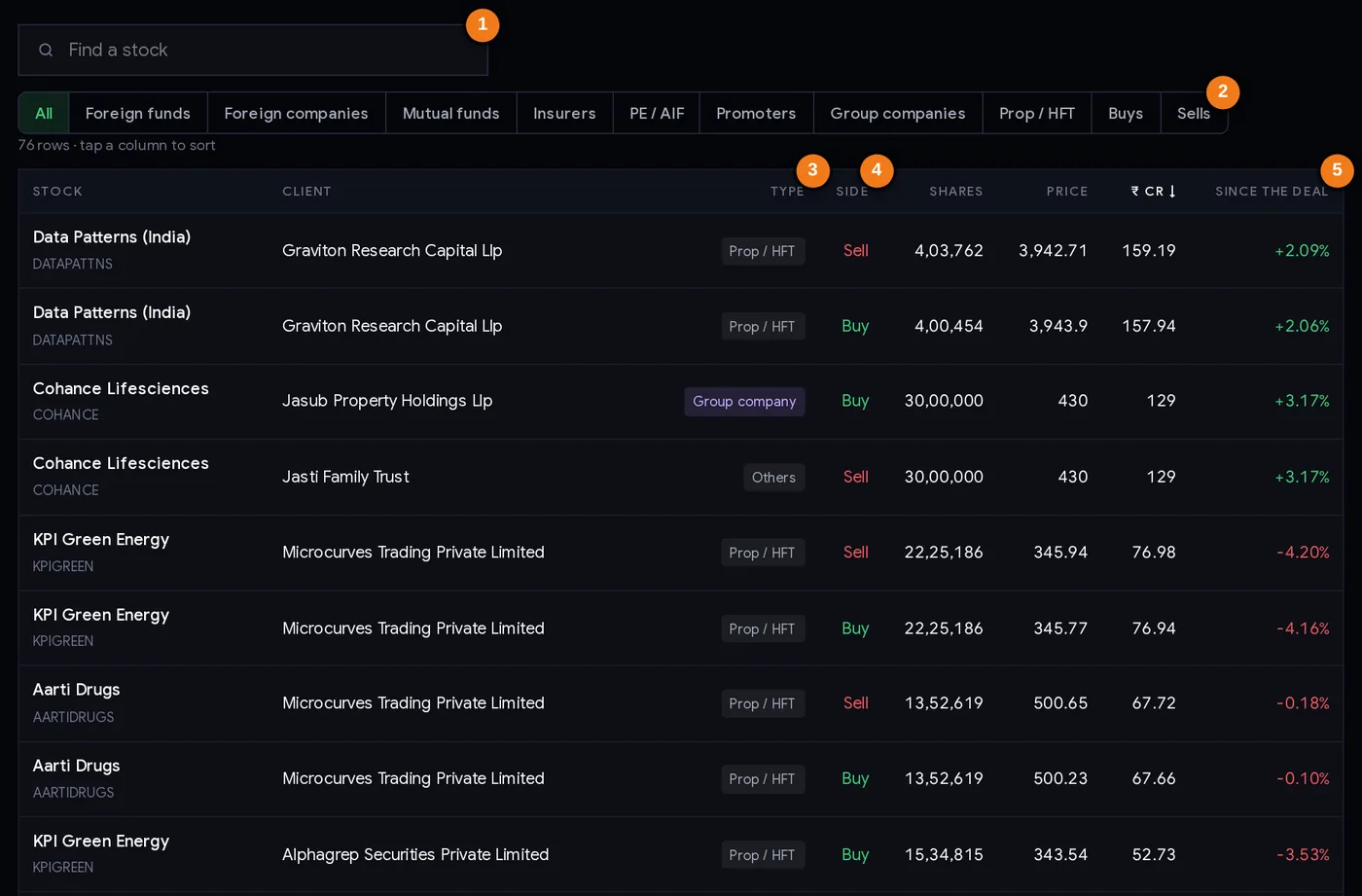
- 1Find a stock
- 2One-tap filters by investor type and by side
- 3Type: the kind of investor, from the company’s shareholding filing where possible
- 4Side: buy or sell
- 5Since the deal: latest close vs deal price
Every column explained
| Column / control | What it tells you |
|---|---|
| Find a stock | Type a name or symbol to filter the table. |
| Filter buttons | All, Foreign funds, Foreign companies, Mutual funds, Insurers, PE / AIF, Promoters, Group companies, Prop / HFT, and Buys or Sells only. One tap, no menus. |
| Stock | Company name and symbol. Click it to open the stock’s page, which also shows its deals on a timeline. |
| Client | The buyer or seller exactly as NSE reports it. |
| Type | The investor type: from the company’s shareholding filing where the client is named in it, otherwise from the name (see above). |
| Side | Buy or Sell. |
| Shares / Price / ₹ Cr | Quantity in Indian format (6,02,13,215 = about 6.02 crore shares), the average deal price, and the value in ₹ crore. |
| Since the deal | Latest close compared with the deal price. On the deal day itself this is just the day’s close against the deal price. |
Nirma Limited’s sale of 28,46,300 Alivus Life Sciences shares at ₹1,370 and the big V2 Retail trades appear in both of NSE’s files, but on the page each is one row, marked as a block deal. Nirma is tagged Promoter / group, because Alivus lists it in the promoter section of its shareholding pattern.

The filter buttons are the fastest way to read the day. With “Mutual funds” selected for 6 Nov 2026 you see Bandhan Mutual Fund and Helios Mutual Fund buying Alivus Life Sciences in the block window at ₹1,370, each fund house split into several rows (one per scheme).
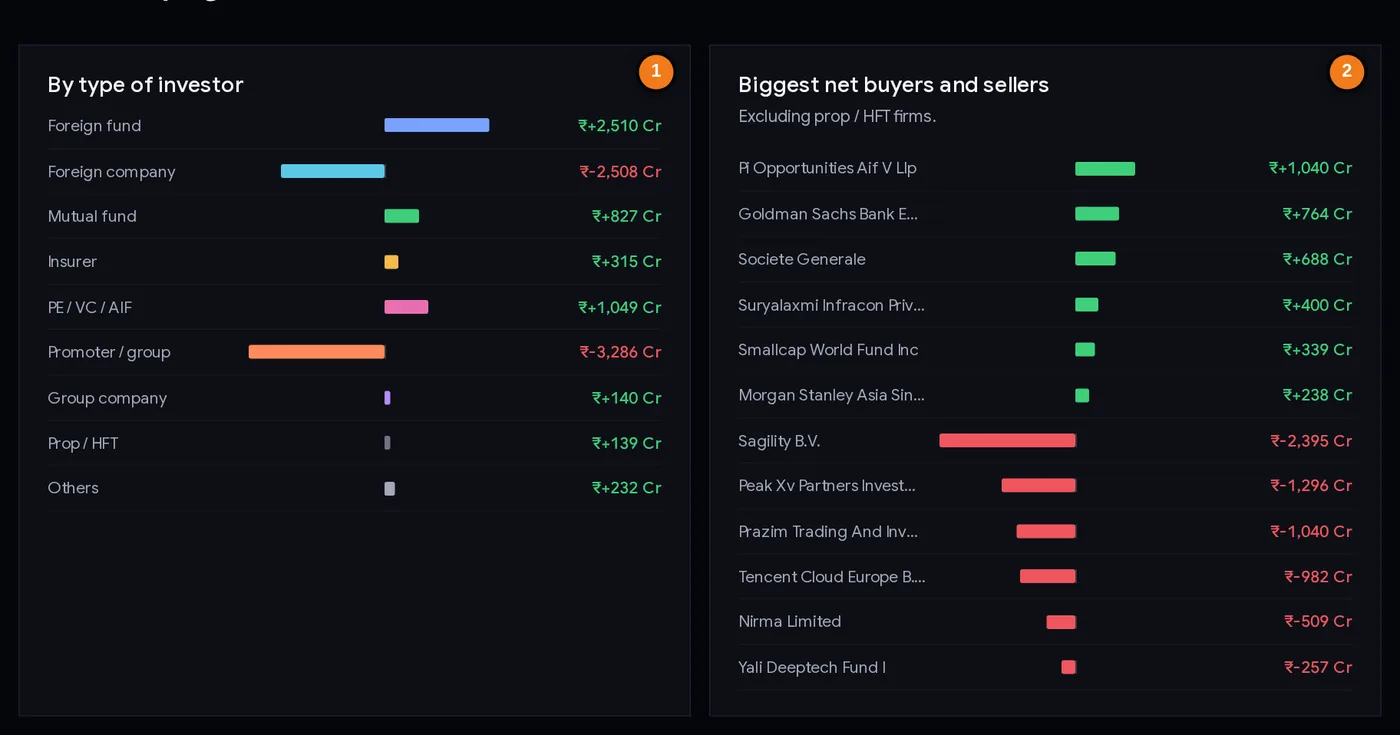
- 1Net buying (green) or selling (red) by type of investor
- 2The largest single net buyers and sellers, prop/HFT left out
Who is buying
The left card nets buys minus sells by investor type since the archive began (16 Oct to 6 Nov 2026, 15 sessions): promoters and groups −₹3,286 crore, foreign companies −₹2,508 crore, foreign funds +₹2,516 crore, PE / VC / AIF +₹1,049 crore, mutual funds +₹827 crore, insurers +₹315 crore, “Others” +₹362 crore. The right card lists the biggest single net buyers and sellers, leaving out prop/HFT firms. Read it with care:
- The largest sellers were mostly owners and early investors: Sagility B.V. (₹2,395 crore), Peak XV Partners (₹1,296 crore, Groww), Tencent Cloud Europe (₹982 crore, Swiggy) and Nirma (₹509 crore, Alivus).
- The top buyer, PI Opportunities AIF V (₹1,040 crore), and a top seller, Prazim Trading and Investment Company (₹1,040 crore), were the two sides of the same trades (see case study 3).
- Each trade is counted once, so these are real amounts. Still check the archive rows before quoting a number: one name can cover several stocks.
Step by step: your evening routine (10 minutes)
- Open the page after about 10:30 PM IST on a trading day (NSE publishes the files in the evening; the page’s full update lands later that night). Check the date in the table heading.
- Sort by ₹ Cr (the default) and read the top ten rows. For each, ask: who is the buyer, who is the seller?
- Tap “Prop / HFT” to see which stocks the trading firms were churning, then mentally set those rows aside.
- Tap “Mutual funds”, “Insurers” and “Foreign funds”. Note any stock where a long-term investor bought.
- Look for the seller. Use “Find a stock” to see both sides of the trade. A promoter or venture fund selling to institutions is a stake transfer, not a vote of confidence by the market as a whole.
- Using NSE’s raw files instead? Remove duplicates first: the same client, quantity and price in both lists is one trade (the page already does this).
- Open the stock page for anything interesting. Check the price chart, delivery, results date and the company’s shareholding pattern.
- Write down the deal price as a reference level. It is information, not an entry signal.
Three playbooks
Playbook A: the institutional block (investors)
A promoter or early investor sells a big block, and several mutual funds, insurers and long-only foreign funds take it. Investors who use this playbook treat it as a reason to study the company, not to buy the next morning: why did long-term funds want shares at this price? They then use the deal price as a reference: if the stock later trades far below it, they ask what the buyers may have missed; if it holds above, the supply from the seller has been absorbed. Any position is sized small and given a clear exit level.
Playbook B: the overhang check (anyone holding the stock)
When a promoter or venture fund sells only part of its stake, more selling may follow. Check the latest shareholding pattern (see shareholding changes) to see how much the seller still holds. Recently listed companies often see early investors sell in stages. Holders use this to decide whether to trim or set a tighter stop loss; it is a risk note, not a sell signal.
Playbook C: ignore the noise
Skip deals that are only prop/HFT round trips, matched transfers between related entities, and tiny SME stocks where one person’s purchase can move the price by itself. Most of the daily list falls in these groups. A quiet evening with nothing worth acting on is a normal result.
Risk first. If a deal prompts a trade, decide your stop loss before entry and size the position so the loss at the stop is a small part of your capital. The position size calculator does the arithmetic.
Case studies from the deal archive
Five real deals from October and November 2026, from NSE’s bulk and block deal files as stored by ChartMine, with closing prices from NSE’s daily bhavcopy. Prices in ₹.
1. Swiggy, 30 Oct 2026: a venture investor sells, institutions buy
Tencent Cloud Europe B.V. sold 5,43,47,662 shares at 180.65 (about ₹982 crore) in the block window. The buyers were named: Societe Generale (₹429 crore), Morgan Stanley Asia Singapore (₹238 crore), Goldman Sachs Bank Europe (₹191 crore), Nippon India Mutual Fund (₹50 crore), Ghisallo Master Fund (₹47 crore) and Aditya Birla Sun Life Mutual Fund (four scheme rows, about ₹27 crore). The stock closed that day at 176.60, below the deal price, and on 6 Nov at 191.17 (+5.8% from the deal price). Lesson: the famous buyers were taking stock from an early investor, partly through foreign bank arms whose end clients are not named. A week earlier, on 23 Oct, Graviton Research Capital (an HFT firm) both bought (1.42 crore shares) and sold (1.44 crore shares) Swiggy on the same day: a typical round trip that tells you nothing about direction.
2. Sagility India, 30 Oct 2026: the promoter sells ₹2,395 crore
The promoter entity Sagility B.V. sold 56 crore shares at 42.76. Buyers included BNP Paribas Financial Markets (₹240 crore), Societe Generale (₹203 crore), Ghisallo Master Fund (₹191 crore), ICICI Prudential Mutual Fund (₹150 crore), ICICI Prudential Life Insurance (₹139 crore) and a Goldman Sachs India equity fund (₹116 crore). About 77 crore shares traded that day, 76% delivered. The stock closed at 42.08 that day and 43.46 on 6 Nov, +1.6% from the deal price. Lesson: a big promoter sale can be absorbed calmly when institutions take it; it was not a crash, and it was not a rally either.
3. 21 Oct 2026: one investor group, both sides of five trades
On the same day PI Opportunities AIF V bought, and Prazim Trading and Investment Company sold, exactly the same number of shares at exactly the same price in five stocks: Adani Energy Solutions (49,53,560 shares at 1,334, ₹661 crore), Manipal Hospitals (₹120 crore), Shriram Pistons (₹115 crore), Aditya Birla Capital (₹112 crore) and Craftsman Automation (₹32 crore). Same quantity, same price, opposite sides, in five stocks on one day: that pattern usually means a transfer between related entities (check the companies’ filings to confirm), not new money coming into these stocks. Yet it put PI Opportunities at the top of the “biggest net buyers” card. Lesson: always read the seller’s name next to the buyer’s.
4. Groww, 6 Nov 2026: an early investor exits part of its stake
Peak XV Partners Investments VI-1 sold 6,02,13,215 shares at 215.20 (₹1,296 crore, the day’s biggest deal). Goldman Sachs Bank Europe SE – ODI bought 3,55,18,249 shares at 215.01 (₹764 crore); the rest went to buyers too small to be named. Close that day: 215.08, right at the deal price, after 223.89 the day before. Lesson: the visible buyer is an ODI issuer, so the real end investors are hidden. Check how much the seller still holds before assuming the selling is over (Playbook B).
5. V2 Retail, 6 Nov 2026: every buyer had a named seller
In the block window Ricon Commodities sold 98,65,000 shares and Ram Chandra Agarwal 62,60,000 shares, all at 160. Aditya Kumar Halwasiya bought 83,00,000 and five other buyers (four individuals and Carbon Resources) bought 15,65,000 each, ₹25.04 crore apiece, just above the ₹25 crore block minimum. Total sold = total bought = 1,61,25,000 shares. Ricon Commodities and Ram Chandra Agarwal are named in V2 Retail’s promoter group, so the page tags them Promoter / group. Meanwhile four HFT firms (QE Securities, Microcurves, AlphaGrep, Mansi Share) traded in and out around 172–174. The stock closed at 173.50, +7.5% on the day and 8.4% above the block price. Lesson: the deal was a pre-arranged transfer at a discount to the market. The same day showed up on the big-money footprint as “bulk/block buying ₹258 Cr”, which is why you must check who sold.
Common mistakes
- Reading a block buy as “smart money is buying” without noticing that someone equally big sold at the same price.
- Counting HFT/prop deals. Their buys and sells mostly cancel out the same day.
- Adding up duplicate rows in NSE’s raw files. One trade in both the bulk and block lists is not two trades. The page shows it once; other sites and spreadsheets often do not.
- Trusting the Type tag blindly. It is exact when the client is named in the company’s shareholding filing, but new buyers are tagged from their names, and plenty of large investors still end up in “Others”.
- Copying a fund’s trade. A fund has a different horizon, size, cost and reason. It can also be wrong, and you will not see when it sells below 0.5%.
- Chasing the next morning’s gap. By the time the file is published, the news is in the price.
- Ignoring SME stocks’ thin liquidity. In small companies, 0.5% can be a few lakh rupees and one buyer can move the price.
Checklist before you act on a deal
- Date checked: these are the latest day’s deals.
- Each trade counted once (the page does this; check it if you use NSE’s raw files).
- Prop/HFT rows set aside.
- Buyer and seller identified: promoter, venture fund, related entity, ODI issuer, mutual fund, insurer?
- Stake left with the seller checked in the shareholding pattern.
- Results date, news and the stock’s chart checked.
- Deal price noted as a reference level, not a signal.
- If you trade: stop loss and position size decided before entry.
Glossary
| Bulk deal | A client’s total trades in a stock in one day add up to more than 0.5% of the company’s listed shares. |
| Block deal | A large trade (minimum order ₹25 crore since December 2025, earlier ₹10 crore) done in one of the two block-deal windows within 3% of the reference price, usually pre-arranged, always delivered. |
| Shareholding pattern | The quarterly filing in which a company lists its promoters and every public shareholder above 1%, by category. The page uses it to tag deal clients. |
| FII / FPI | Foreign institutional / portfolio investor. |
| DII | Domestic institutional investor: mutual funds, insurers, banks, pension funds. |
| Promoter | The founders or controlling group of a company. |
| ODI / P-note | Offshore derivative instrument: a foreign bank holds the Indian shares and gives its client the economic exposure. The client is not named in the deal file. |
| Prop desk / HFT | Firms trading their own money, often by computer, many times a day. |
| Arbitrage | Buying in one place and selling in another (cash vs futures, NSE vs BSE) to earn a small, low-risk difference. |
| AIF | Alternative investment fund: a privately pooled fund for wealthy investors. |
| Since the deal | The latest close compared with the deal price, in %. |
Questions
What is the difference between a bulk deal and a block deal?
A bulk deal is any client’s trading in a stock that adds up to more than 0.5% of the company’s listed shares in one day, in the normal market. A block deal is one large, usually pre-arranged trade done in a separate block-deal window. A block trade larger than 0.5% of the company is reported in both lists.
What is the minimum size of a block deal in India?
₹25 crore per order, since December 2025 (SEBI circular of 8 Oct 2025; it was ₹10 crore before). Block trades happen in two windows, 8:45 to 9:00 AM and 2:05 to 2:20 PM, within 3% of the reference price, and must be delivered. One order can be filled against several counterparties, so individual rows in NSE’s list can be smaller.
Where can I see today’s bulk and block deals with names?
NSE publishes both files every trading evening. ChartMine’s Bulk & block deals page shows them with the client name, an investor-type tag, the value in ₹ crore and how the stock has moved since the deal price.
Is a bulk deal buy a bullish signal?
Not on its own. Every buy has a seller, many large deals are promoter or early-investor sales, and prop/HFT firms churn in and out. In ChartMine’s three-week test, stocks with a named non-prop buyer did slightly better after 5 sessions but not after 10. Treat deals as information and manage risk with a stop loss.
Why do HFT firms like Jump Trading or HRTI appear in bulk deals so often?
High-frequency and proprietary trading firms buy and sell very large quantities inside the same day to earn small price differences. Their total can cross 0.5% of a company even though they end the day with almost no position.
Why does the same deal appear in both NSE lists?
A block-window trade that is also more than 0.5% of the company is reported in NSE’s bulk list and its block list. It is one trade, so ChartMine shows it once, as a block deal, and counts it once in every total.
How does ChartMine know if a client is a promoter?
It looks the client up in the company’s latest shareholding pattern, which names every promoter and every public shareholder above 1%. A client in the promoter section is tagged Promoter / group. Clients not in the filing are tagged from their names, which is less exact.
What does ‘Since the deal’ mean?
It compares the stock’s latest closing price with the deal price. A positive number means the stock now trades above the price the deal was done at.