
☰ All tutorials
Start here
Tool tutorialsHow to trade with ChartMineStocks
Stock monitorMy watchlistStock scores & checklistMarket & sectors
Nifty 50Bank NiftySensexFin NiftyDaily market reportMarket breadthSector rotationSector heatmapStock screenerRelative strength (RS)MCX commodity pricesFear & Greed IndexWhat happens after…Scanners
Top gainers & losersStocks to watch tomorrowNR7 stocks scannerInside bar stocks52-week high stocksGap up & gap down stocksRSI oversold stocksGolden cross stocksSuperTrend buy stocksScan builderEMA 9/21 crossoverMACD crossoverADX strong trendBollinger breakout / squeezeVolume spike stocksOpen = high / open = lowCandlestick pattern scannerNarrow CPR scannerF&O data
F&O ban listOI build-upOption chainPCR & max painExpiry calendarF&O lot sizesOI build-up heatmapPCR trendMax pain trendFutures basisStock screens
Quarterly growersProfit growth stocksLow P/E stocksMutual fund buyingNear 52-week low, growingDebt-free companiesHigh ROE & ROCEMagic Formula stocksLow price-to-bookSmart money
FII / DII dataShareholding changesBig-money footprintShort selling dataF&O positions by participantBulk & block dealsPromoter buyingDelivery percentageCalendars
Results calendarQuarterly results trackerBoard meetingsCorporate actionsIPO calendarIPO performanceResearch & planning
Strategy testerCompare stocksDividend yield stocksASM / GSM listExpiry-day movesSeasonality & stock historyNSE holidays 2026Position size calculatorOption payoff calculatorPivot point calculatorMore
Stock scanners hubStock screensHow to use the corporate actions calendar
A plain-language guide to dividends, bonus issues, stock splits, rights issues and buybacks: what the ex-date means, how the price adjusts, how to read the calendar, and what real ex-dates show.
What corporate actions are, in plain words
A corporate action is something a company does that changes what its shareholders own or receive: paying a dividend, giving free bonus shares, splitting its shares, offering new shares to existing holders (a rights issue), or buying shares back.
Every one of these has an ex-date: the day from which the share trades without the benefit. If you own the share before the ex-date, you get the dividend or the bonus; if you buy on or after it, you do not. On the ex-date the share price adjusts, sometimes sharply. A ₹1,964 share can open at ₹979 and nobody has lost money.
The corporate actions calendar lists every upcoming ex-date on NSE for the next 45 days with the dividend yield on today’s price, shows the next two weeks day by day, and measures how prices actually moved on past ex-dividend days.
One line to remember: a corporate action moves value from one pocket to another. The share price adjusts on the ex-date so that, before tax and costs, your total wealth is roughly unchanged.
The five types, with real examples
| Action | What you get | What happens to the price on the ex-date |
|---|---|---|
| Dividend | Cash per share, e.g. “Interim Dividend - Rs 8 Per Share” (ONGC, ex-date 12 Nov 2026). | Falls by roughly the dividend amount. |
| Bonus | Free shares in a ratio. 1:1 = one new share for each one held. | Divides by (old + new) ÷ old. 1:1 halves the price. |
| Stock split | Each share becomes several of lower face value, e.g. ₹10 into five of ₹2. | Divides by the split ratio (÷5 in that example). |
| Rights issue | The right to buy new shares, usually at a discount, in a ratio such as 2:15 (two new for every 15 held). | Adjusts down a little, reflecting the cheaper new shares. |
| Buyback | An offer from the company to buy your shares, usually at a premium, through a tender. | No formula: the price moves with demand, and the ex-date is the last chance to qualify. |
Dividend words
- Interim dividend: declared during the year, often with quarterly results. Almost all of the 32 dividends listed on 9 Nov 2026 were interim.
- Final dividend: declared after the full-year accounts, approved at the annual general meeting.
- Special dividend: a one-off extra payment (Navneet Education had “Special Dividend - Rs 1.50 Per Share” plus an interim of ₹1.50, ex 11 Nov 2026).
- Dividend yield: dividend ÷ share price. The calendar shows it on the latest close. ONGC’s ₹8 was a 3.45% yield; HUL’s ₹19 was 0.95%.
- Face value: the nominal value printed on a share (₹1, ₹2, ₹10). Companies sometimes quote dividends as a % of face value; the calendar always shows rupees per share.
Ex-date and record date
The record date is when the company checks its register of shareholders. Since India moved to T+1 settlement (shares bought today reach your demat account the next working day), the ex-date and the record date are usually the same day. So to receive a dividend you must buy at the latest on the trading day before the ex-date, and you can sell on the ex-date itself and still receive it.
The arithmetic: work out the ex-date price yourself
You only need simple division to know what “no change” looks like on an ex-date. Compare the ex-date price with this adjusted previous close, not with the raw number on the screen.
| Action | Adjusted previous close | Example |
|---|---|---|
| Dividend | Previous close − dividend | Petronet LNG, 6 Nov 2026: ₹317.00 − ₹7 = ₹310.00 |
| Bonus a:b (a new for every b held) | Previous close × b ÷ (a + b) | 1:1 bonus: × 1 ÷ 2, so the price halves |
| Split from face value F to f | Previous close × f ÷ F | ₹5 to ₹1: × 1 ÷ 5 |
| Split and bonus together | Apply both | Bajaj Finance 2025: ÷ 2 for the split, then ÷ 5 for the 4:1 bonus = ÷ 10 |
Your number of shares changes the opposite way: a 1:1 bonus doubles them, a ₹10-to-₹2 split multiplies them by five. Multiply the new price by the new number of shares and the value of your holding should be about what it was.
Buybacks and rights in a little more detail
In a tender buyback the company offers a fixed price, usually above the market price, for a fixed number of shares. If more shares are offered than the company wants to buy, it accepts them in proportion (the “acceptance ratio”), with a portion reserved for small shareholders. The share price usually stays below the buyback price because not every share you tender will be accepted. On 9 Nov 2026 the calendar listed buyback record dates for Jyothy Labs (11 Nov), FDC (13 Nov) and Medi Assist (20 Nov).
In a rights issue you receive a “rights entitlement” in your demat account, which you can use to buy the new shares at the offer price, sell on the exchange, or let lapse. If you do nothing, your share of the company shrinks.
Why it matters: advantages and limits
✅ No false alarms
A share that “crashed 50%” on a bonus ex-date did not crash. Knowing the calendar stops you panicking or misreading a chart.
✅ Know when to own
The ex-date tells you exactly when you must hold the share to receive a dividend, bonus or buyback entitlement.
✅ Yield at today’s price
The yield column puts every dividend on the same scale, so ₹19 on HUL (0.95%) and ₹8 on ONGC (3.45%) can be compared.
✅ Real ex-date behaviour
The page measures how far prices actually fell on past ex-dividend days, instead of relying on textbook theory.
What the data says about ex-dividend days
The page studies 1,532 dividends with a yield of 0.5% or more since mid-2024. The median stock opened 49% of the dividend lower than the previous close, and closed the day 98% of the dividend lower. In plain words: by the end of the ex-date, the price had typically fallen by almost exactly the dividend. The rest of each day’s move is ordinary trading, which is why individual cases vary wildly.
The “dividend trick” does not work. Buying the day before the ex-date to “collect” a dividend usually leaves you with a share that is worth less by about the same amount, plus a dividend on which you pay income tax at your slab rate, plus brokerage. It is not free money.
Limits
- Dates and amounts come from NSE’s corporate filings and can change. Check the exchange filing before acting.
- The list covers 45 days ahead; actions not yet approved by the board are not on it (see board meetings).
- The ex-dividend study is a median: any single day can be very different.
A tour of the corporate actions screen
Open the corporate actions calendar. It has four parts: the counts, the two-week calendar, the full table of upcoming ex-dates, and the record of past ex-dividend days.
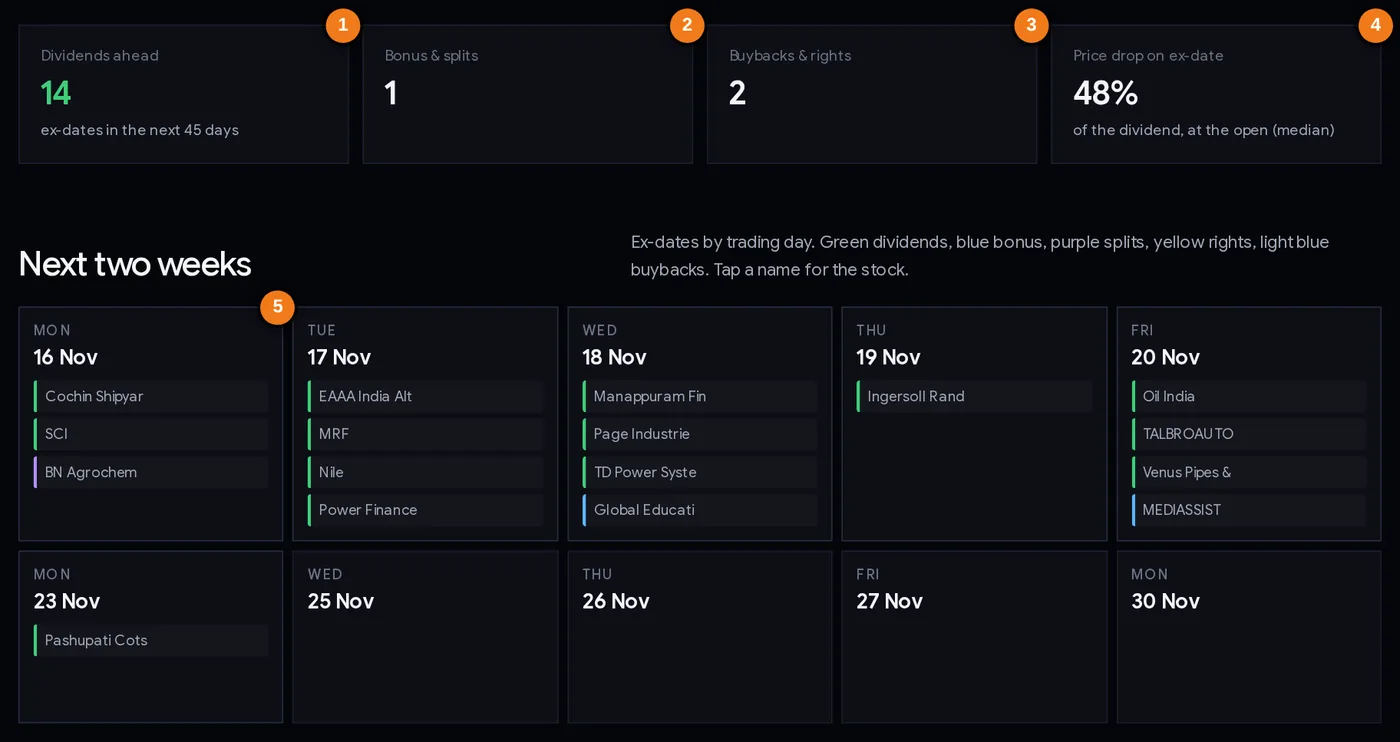
- 1Dividends going ex in the next 45 days
- 2Bonus issues and splits
- 3Buybacks and rights
- 4Median price drop at the open on ex-dividend days, as a share of the dividend
- 5Ex-dates by day; colour shows the action
Each day in the two-week calendar lists the companies going ex that day, coloured by action: green dividends, blue bonus, purple splits, yellow rights, light blue buybacks. Hover over a name to see the details; click it to open the stock page. Notice that on 9 Nov 2026 the calendar jumped from Monday 9 Nov to Wednesday 11 Nov: Tuesday 10 Nov was a market holiday, so no ex-dates fell on it.
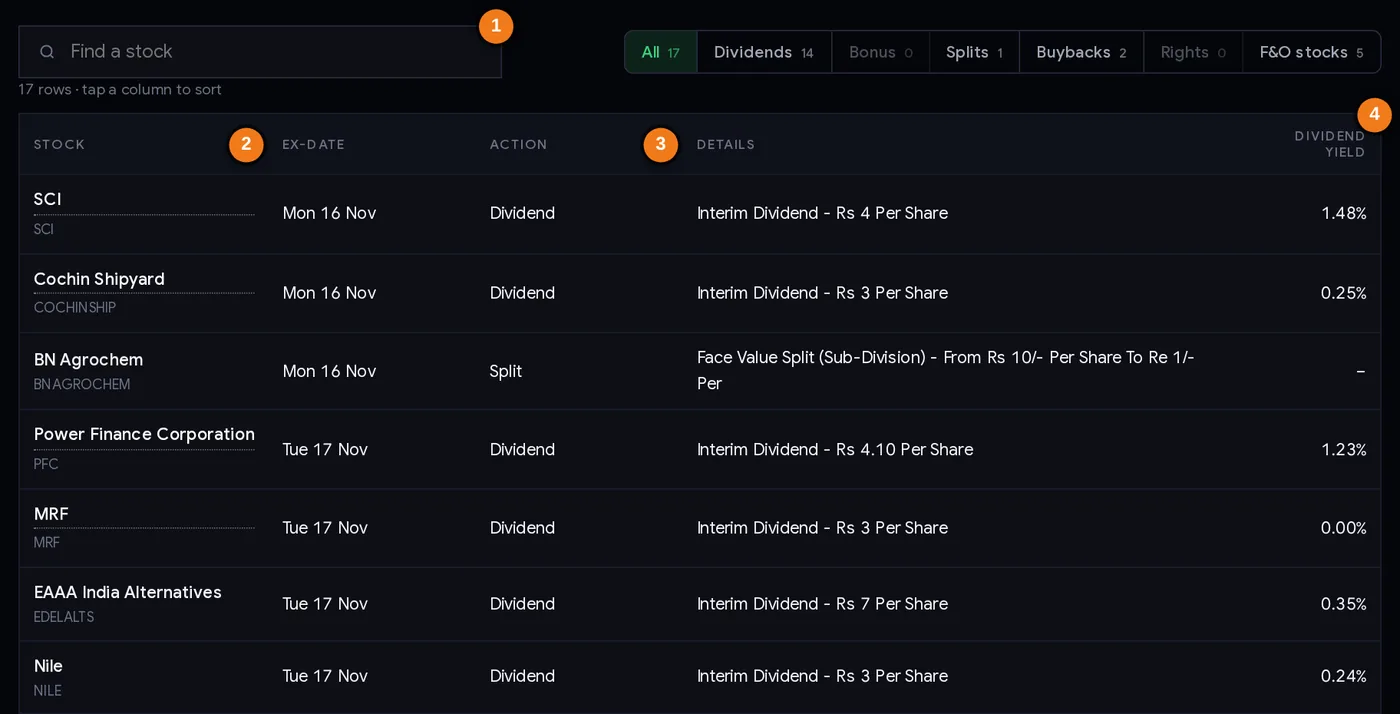
- 1Search and action filters
- 2Ex-date
- 3Details as filed (amount per share, ratio)
- 4Dividend yield on the latest close
| Column | What it tells you |
|---|---|
| Stock | Company and symbol. |
| Ex-date | First day without the entitlement. Own it before this day. |
| Action | Dividend, Bonus, Split, Rights or Buyback. |
| Details | The text from the filing: amount per share, ratio or price. |
| Dividend yield | Dividend ÷ latest close. Blank for non-dividend actions. |
Use the buttons to show only dividends, bonus issues, splits, buybacks, rights or F&O stocks; click a column header to sort, for example by yield.
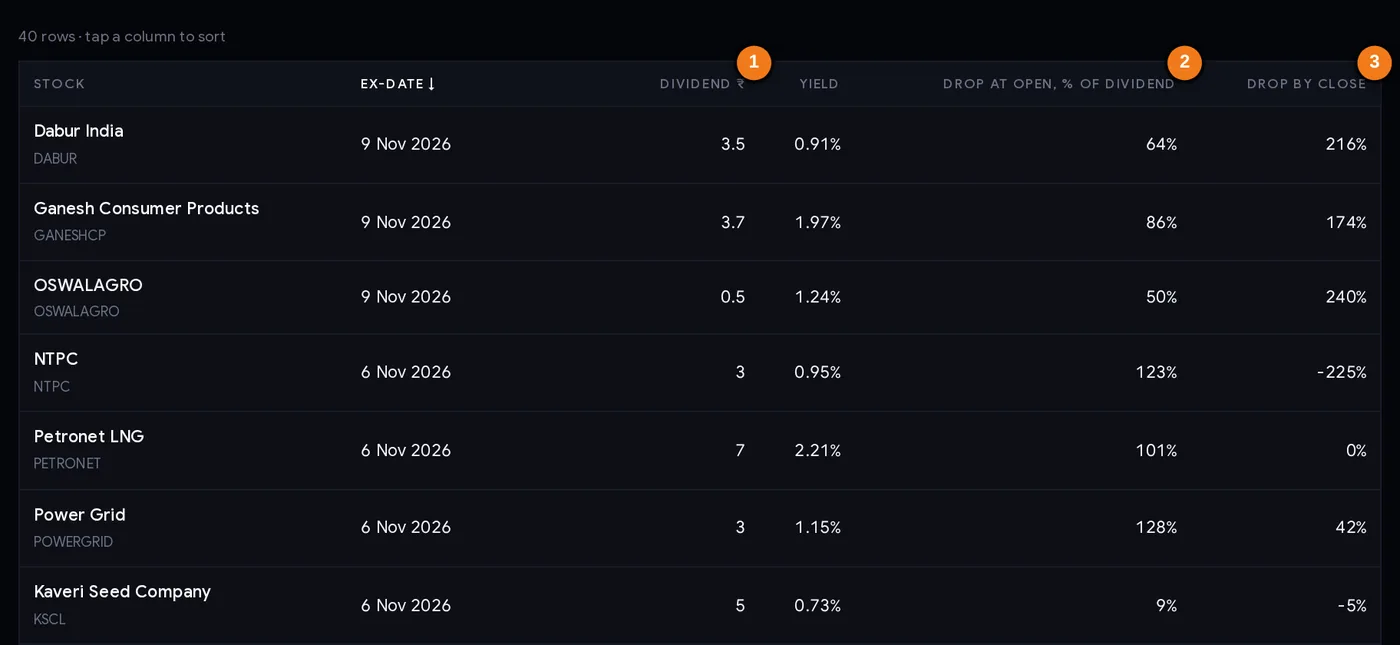
- 1Dividend per share
- 2Fall at the open, as % of the dividend
- 3Fall by the close, as % of the dividend (negative = the price rose)
The last table shows the latest 40 dividends of 0.5% yield or more and how the price behaved. Drop at open, % of dividend: 100% means the share opened lower by exactly the dividend. Drop by close: the same measured at the close. A negative number means the price ended higher than the previous close despite paying out the dividend.
Step by step: using the calendar
- Open the calendar weekly and search for the stocks you own.
- For each dividend, note the ex-date and amount. If you want the dividend, make sure you own the share by the close of the trading day before the ex-date.
- Expect the price drop. On the ex-date, mentally add the dividend back before judging the day’s move.
- For a bonus or split, expect the price to divide by the ratio and your share count to multiply by it. Your holding value stays about the same.
- Check your F&O positions. For bonus issues, splits and large dividends, the exchange adjusts futures and options contracts (strike prices and lot sizes); look up the adjusted contracts before the ex-date.
- For a buyback, read the details: the price, the record date and how many shares retail holders can tender.
- For a rights issue, decide before the deadline whether to subscribe, sell your rights entitlement, or let it lapse.
- After the ex-date, check the past ex-dividend table to see how the price actually behaved.
Three playbooks
Playbook A: the income investor
Use the calendar together with the dividend yield stocks list. Look for companies that pay a meaningful yield regularly, not just once, and buy them for the business, holding through many ex-dates. One quarter’s high yield after a price fall can signal trouble rather than value.
Playbook B: reading charts correctly
Before acting on any big one-day “fall” on a chart, check whether that day was an ex-date. ChartMine’s results calendar and IPO scorecard use prices adjusted for bonus issues and splits, but some charts and data feeds are not adjusted. An unadjusted chart can show a 50% or 90% collapse that never happened.
Playbook C: the trader’s ex-date filter
If you trade short term, do not treat the ex-date drop as a signal. The median stock opened about half the dividend lower and closed about the full dividend lower, but single days varied widely: on 6 Nov 2026 NTPC closed above its previous close while NALCO closed 117% of its dividend lower. Many traders simply skip new entries on the ex-dates of large dividends, and always keep a stop loss.
Taxes and costs matter. Dividends are taxed as income at your slab rate. Check the current rules with a tax adviser; ChartMine does not give tax or investment advice.
Case studies from real ex-dates
Prices are from NSE’s daily files: “previous close” is the close before the ex-date.
1. HDFC Bank 1:1 bonus, 26 Aug 2025
Previous close: ₹1,964.10. On the ex-date the share opened at ₹979.50 and closed at ₹973.40. It looks like a 50% crash. It was not: with one free share for every share held, the fair adjusted previous close was ₹1,964.10 ÷ 2 = ₹982.05, so the real move was about −0.9%. A holder of 100 shares worth ₹1,96,410 now had 200 shares worth ₹1,94,680.
2. Bajaj Finance split and bonus, 16 Jun 2025
Bajaj Finance split each ₹2 share into two ₹1 shares and gave a 4:1 bonus (four free shares for each held) on the same ex-date. Every old share became 2 × 5 = 10 shares. Previous close: ₹9,331; ex-date close: ₹938. Adjusted previous close ₹933.10, so the real move was about +0.5%.
3. NTPC and Petronet LNG dividends, 6 Nov 2026
NTPC paid ₹3 (yield 0.95%). Previous close ₹316.70; it opened at ₹313.00, ₹3.70 lower (123% of the dividend), then rallied to close at ₹323.45, above the previous close (the table shows −225%). Petronet LNG paid ₹7 (2.21%). Previous close ₹317.00; it opened at ₹309.95, almost exactly the dividend lower (101%), and closed back at ₹317.00 (0%). Lesson: the opening drop is roughly the dividend; the rest of the day is the market.
4. Kotak Mahindra Bank split, 14 Jan 2026
Face value split from ₹5 to ₹1: each share became five. Previous close ₹2,132.60; ex-date close ₹421.00. Adjusted previous close ₹426.52, so the real move was about −1.3%. The share became affordable one unit at a time; nothing about the bank changed.
Common mistakes
- Panicking at a bonus or split “crash”. Divide the previous close by the ratio before judging.
- Buying on the ex-date to get the dividend. Too late: you must own it before the ex-date.
- Buying just for the dividend. The price falls by about the dividend, and the dividend is taxed.
- Chasing a high one-off yield. A special dividend or a fallen share price can inflate the yield.
- Ignoring F&O adjustments on bonus, split and large-dividend ex-dates.
- Using unadjusted charts for indicators and backtests.
- Assuming a buyback means you can sell everything at the buyback price. Tendered shares are accepted in proportion; often only part is bought.
Corporate action checklist
- I know the action, the amount or ratio, and the ex-date.
- I own the share by the close of the trading day before the ex-date, if I want the benefit.
- I have adjusted my expectations for the ex-date price change.
- I have checked any F&O contract adjustments.
- I understand the tax on dividends for my situation.
- For buybacks and rights, I know the deadline and my options.
- I am using adjusted prices when reading charts or running backtests.
Glossary
| Corporate action | A company decision that changes what shareholders own or receive. |
| Ex-date | The first trading day without the entitlement. |
| Record date | The date the company checks who its shareholders are; under T+1 usually the same as the ex-date. |
| T+1 | Settlement one working day after the trade. |
| Dividend yield | Dividend per share ÷ share price. |
| Bonus ratio | New shares : shares held. 1:1 doubles your shares. |
| Split | Dividing a share into several of lower face value. |
| Rights issue | New shares offered to existing holders in a ratio, usually at a discount. |
| Buyback | The company buying back its own shares, usually by tender at a fixed price. |
| Adjusted price | Past prices rescaled for bonus issues and splits so charts stay comparable. |
Questions
What is an ex-date?
The first day a share trades without the right to an upcoming dividend, bonus or split. To receive it you must own the share before the ex-date. With T+1 settlement the ex-date and the record date are usually the same day.
Which stocks go ex-dividend this week?
The corporate actions calendar shows the next two weeks day by day and lists every dividend ex-date in the next 45 days with its yield on today’s price. On 9 Nov 2026 it listed 32 dividends.
If I sell on the ex-date, do I still get the dividend?
Yes. If you owned the share at the close of the day before the ex-date, you are entitled to the dividend even if you sell on the ex-date.
What is the difference between a bonus issue and a stock split?
A bonus gives free new shares out of the company’s reserves; a split divides each share into smaller ones of lower face value. Both lower the share price in proportion without changing the value of your holding.