
☰ All tutorials
Start here
Tool tutorialsHow to trade with ChartMineStocks
Stock monitorMy watchlistStock scores & checklistMarket & sectors
Nifty 50Bank NiftySensexFin NiftyDaily market reportMarket breadthSector rotationSector heatmapStock screenerRelative strength (RS)MCX commodity pricesFear & Greed IndexWhat happens after…Scanners
Top gainers & losersStocks to watch tomorrowNR7 stocks scannerInside bar stocks52-week high stocksGap up & gap down stocksRSI oversold stocksGolden cross stocksSuperTrend buy stocksScan builderEMA 9/21 crossoverMACD crossoverADX strong trendBollinger breakout / squeezeVolume spike stocksOpen = high / open = lowCandlestick pattern scannerNarrow CPR scannerF&O data
F&O ban listOI build-upOption chainPCR & max painExpiry calendarF&O lot sizesOI build-up heatmapPCR trendMax pain trendFutures basisStock screens
Quarterly growersProfit growth stocksLow P/E stocksMutual fund buyingNear 52-week low, growingDebt-free companiesHigh ROE & ROCEMagic Formula stocksLow price-to-bookSmart money
FII / DII dataShareholding changesBig-money footprintShort selling dataF&O positions by participantBulk & block dealsPromoter buyingDelivery percentageCalendars
Results calendarQuarterly results trackerBoard meetingsCorporate actionsIPO calendarIPO performanceResearch & planning
Strategy testerCompare stocksDividend yield stocksASM / GSM listExpiry-day movesSeasonality & stock historyNSE holidays 2026Position size calculatorOption payoff calculatorPivot point calculatorMore
Stock scanners hubStock screensHow to use the NSE holidays 2026 calendar
Every NSE holiday in 2026 by segment, the long weekends, Muhurat trading and other special sessions, and how holidays shift F&O expiry, settlement and your risk.
What the NSE holiday calendar is
The stock market does not trade every weekday. On national and festival holidays NSE and BSE stay closed. Each December the exchanges publish the next year’s list. The NSE holidays 2026 page shows that list for every segment (equity, F&O, currency and commodity), a month-by-month calendar, the next holiday, the number of trading days left, and the long weekends.
In 2026 there are 20 equity and F&O holidays. Four of them fall on a Saturday or Sunday, so the market loses 16 weekdays. Seven holidays fall on a Monday or a Friday and make a long weekend.
Why bother? Holidays move F&O expiry days, delay the settlement of your trades and dividend ex-dates, and leave you unable to exit a position for one or more extra days. A trader who forgets a holiday can find an option expiring a day earlier than planned.
The 2026 holidays at a glance
The equity and F&O market is closed on these weekdays in 2026:
| Date | Day | Holiday |
|---|---|---|
| 15 Jan | Thursday | Municipal Corporation Election, Maharashtra |
| 26 Jan | Monday | Republic Day |
| 3 Mar | Tuesday | Holi |
| 26 Mar | Thursday | Shri Ram Navami |
| 31 Mar | Tuesday | Shri Mahavir Jayanti |
| 3 Apr | Friday | Good Friday |
| 14 Apr | Tuesday | Dr. Baba Saheb Ambedkar Jayanti |
| 1 May | Friday | Maharashtra Day |
| 28 May | Thursday | Bakri Id |
| 26 Jun | Friday | Muharram |
| 14 Sep | Monday | Ganesh Chaturthi |
| 2 Oct | Friday | Mahatma Gandhi Jayanti |
| 20 Oct | Tuesday | Dussehra |
| 10 Nov | Tuesday | Diwali Balipratipada |
| 24 Nov | Tuesday | Prakash Gurpurb Sri Guru Nanak Dev |
| 25 Dec | Friday | Christmas |
Four more holidays fall on a weekend: Mahashivratri (Sunday 15 Feb), Id-Ul-Fitr (Saturday 21 Mar), Independence Day (Saturday 15 Aug) and Diwali Laxmi Pujan (Sunday 8 Nov). The long weekends come from the Monday and Friday holidays: 26 Jan, 3 Apr, 1 May, 26 Jun, 14 Sep, 2 Oct and 25 Dec.
Segments are not all the same
- Equity and F&O always share the same holidays.
- Currency also closes on some bank holidays: 19 Feb (Chhatrapati Shivaji Maharaj Jayanti), 19 Mar (Gudi Padwa), 1 Apr (annual bank closing) and 26 Aug (Id-E-Milad), when equity trades normally.
- Commodity has a morning and an evening session. On many equity holidays the morning session is closed but the evening session opens (for example Holi, Dussehra and Diwali Balipratipada). On 1 Jan 2026 only commodity closed, and only in the evening.
Muhurat trading and other special sessions
Muhurat trading is a special, roughly one-hour session held on Diwali, the day traditionally seen as the start of a new Samvat (Hindu calendar) year. The market is officially on holiday for Diwali Laxmi Pujan, but the exchanges open for this symbolic session. Many investors buy a token amount of shares as an auspicious start. The timing changes every year and is announced in an exchange circular: in 2024 it was 6:00 to 7:00 PM, and in 2025, for the first time, an afternoon session from 1:45 to 2:45 PM. In 2026 the session was held on Sunday 8 Nov.
How NIFTY behaved on Muhurat days
| Muhurat session | NIFTY change in the session | Next trading day |
|---|---|---|
| Thu 4 Nov 2021 | +0.49% | +0.85% (8 Nov) |
| Mon 24 Oct 2022 | +0.88% | −0.42% (25 Oct) |
| Sun 12 Nov 2023 | +0.52% | −0.42% (13 Nov) |
| Fri 1 Nov 2024 | +0.41% | −1.27% (4 Nov) |
| Tue 21 Oct 2025 | +0.10% | +0.09% (23 Oct) |
| Sun 8 Nov 2026 | −0.18% | – |
Five of the six sessions closed higher, but by small amounts, and the next day fell in three of the five years. With only six data points this is a tradition, not a pattern to trade. Liquidity in a one-hour session is thin, and spreads can be wide.
Short sessions distort indicators. A one-hour session gives every stock a tiny high-low range. In its scan of the 8 Nov 2026 Muhurat session, ChartMine’s narrow CPR scanner listed 219 of 239 instruments as narrow. That was the short session, not 219 real setups. Treat volume, range and pivot-based signals from Muhurat day with care.
Other special sessions
The exchanges sometimes open on a weekend for an important event. On Sunday 1 Feb 2026 they held a full trading session for the Union Budget: NIFTY closed 1.96% lower than on Friday 30 Jan. Such sessions are announced by circular a few weeks ahead.
Why holidays matter to traders: advantages and limits
✅ Expiry days move
When an expiry day is a holiday, the contract expires on the previous trading day.
✅ Settlement and ex-dates shift
T+1 means the next working day, so a holiday pushes delivery and dividend eligibility out by a day.
✅ Plan around gaps
News piles up while the market is shut. You cannot exit until it reopens.
✅ Count trading days
Option time decay, swing trades and SIP dates all depend on how many sessions are left.
What the data says about the day after a holiday
We compared NIFTY on every trading day since 2016 that followed a weekday holiday (146 days) with all other days (2,531).
| Measure (median) | Day after a weekday holiday | Other days |
|---|---|---|
| Size of the opening gap | 0.33% | 0.27% |
| Size of the day’s move (close to close) | 0.72% | 0.50% |
The day after a holiday tends to move a little more, because two or more days of news are priced in at once. It is a reason to size positions a bit smaller over long weekends, not a directional signal.
Limits
- Exchanges can add or change holidays at short notice (for example for elections). Always check the latest NSE circular.
- The page covers NSE; BSE’s list is normally the same for equity, but check it if you trade there.
- Muhurat and special-session timings are announced separately and are not on the holiday list itself.
How holidays move F&O expiry days in 2026
NIFTY weekly options expire on Tuesdays in 2026. When a Tuesday is a holiday, expiry moves to the previous trading day, Monday. From ChartMine’s expiry data:
| Holiday (Tuesday) | NIFTY expiry moved to |
|---|---|
| Holi, 3 Mar | Monday 2 Mar |
| Mahavir Jayanti, 31 Mar | Monday 30 Mar (also the monthly expiry for Bank Nifty and others) |
| Ambedkar Jayanti, 14 Apr | Monday 13 Apr |
| Dussehra, 20 Oct | Monday 19 Oct |
| Diwali Balipratipada, 10 Nov | Monday 9 Nov |
| Guru Nanak Jayanti, 24 Nov | Monday 23 Nov (also the November monthly expiry) |
An option you expected to hold until Tuesday expires a day earlier, with one day less of time value. Option sellers and buyers both need to account for this. See every date on the expiry calendar.
A tour of the holidays page
Open the NSE holidays 2026 page. It has a summary row, a full-year calendar and the detailed list.

- 1Equity and F&O holidays in 2026
- 2The next holiday
- 3Trading days left this year
- 4Holidays that make a long weekend
“Next holiday” and “Trading days left” update with today’s date. On 9 Nov 2026 the next holiday was 10 Nov (Diwali Balipratipada, in 1 day) and 37 trading days were left in the year.
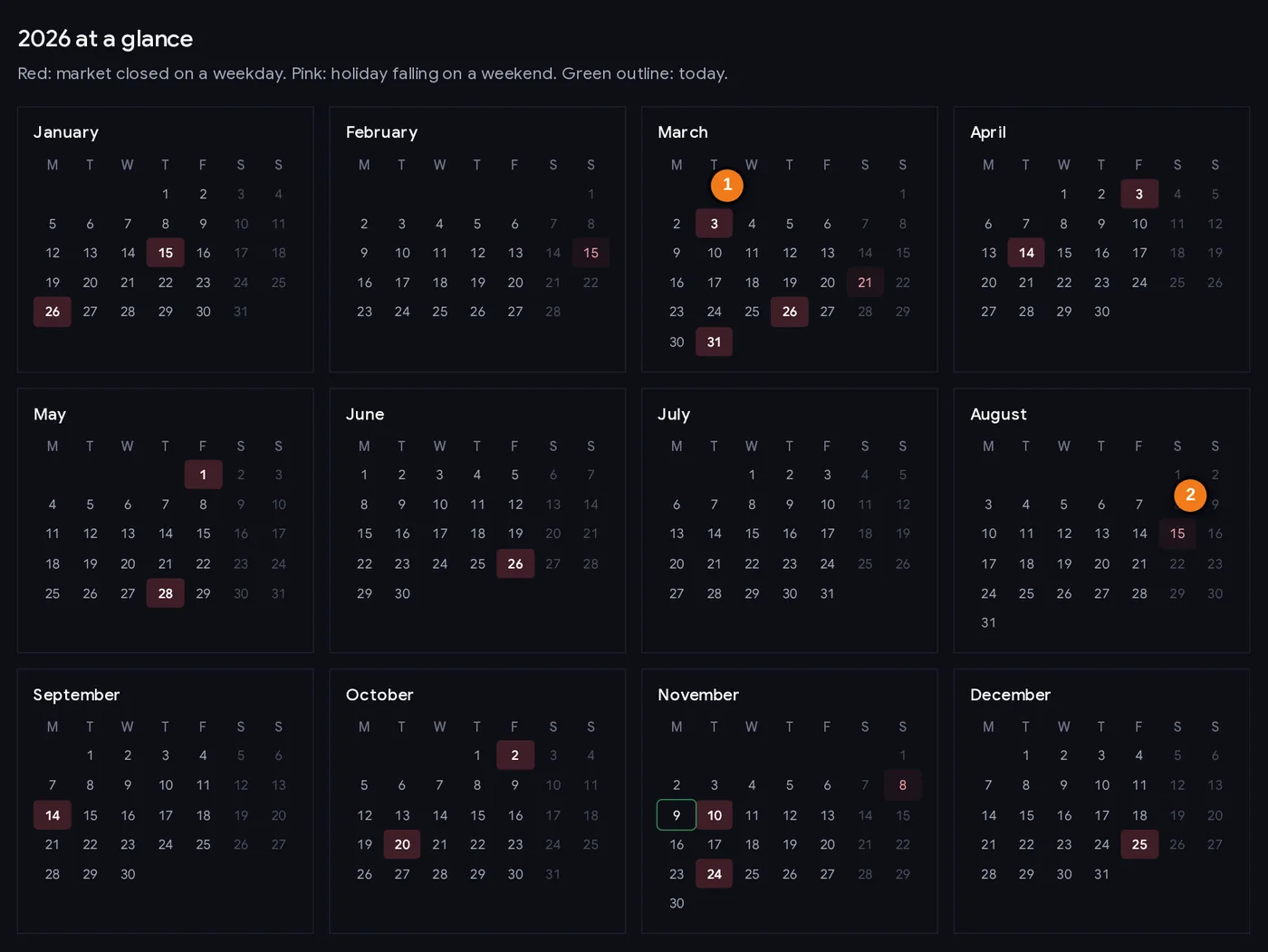
- 1A weekday holiday (Holi, Tuesday 3 Mar)
- 2A holiday that falls on a weekend (Independence Day, Saturday 15 Aug)
Every month at a glance: red cells are weekday holidays (market closed), pink cells are holidays that fall on a weekend, grey numbers are weekends, and today has a green outline. Hover over a holiday to see its name.
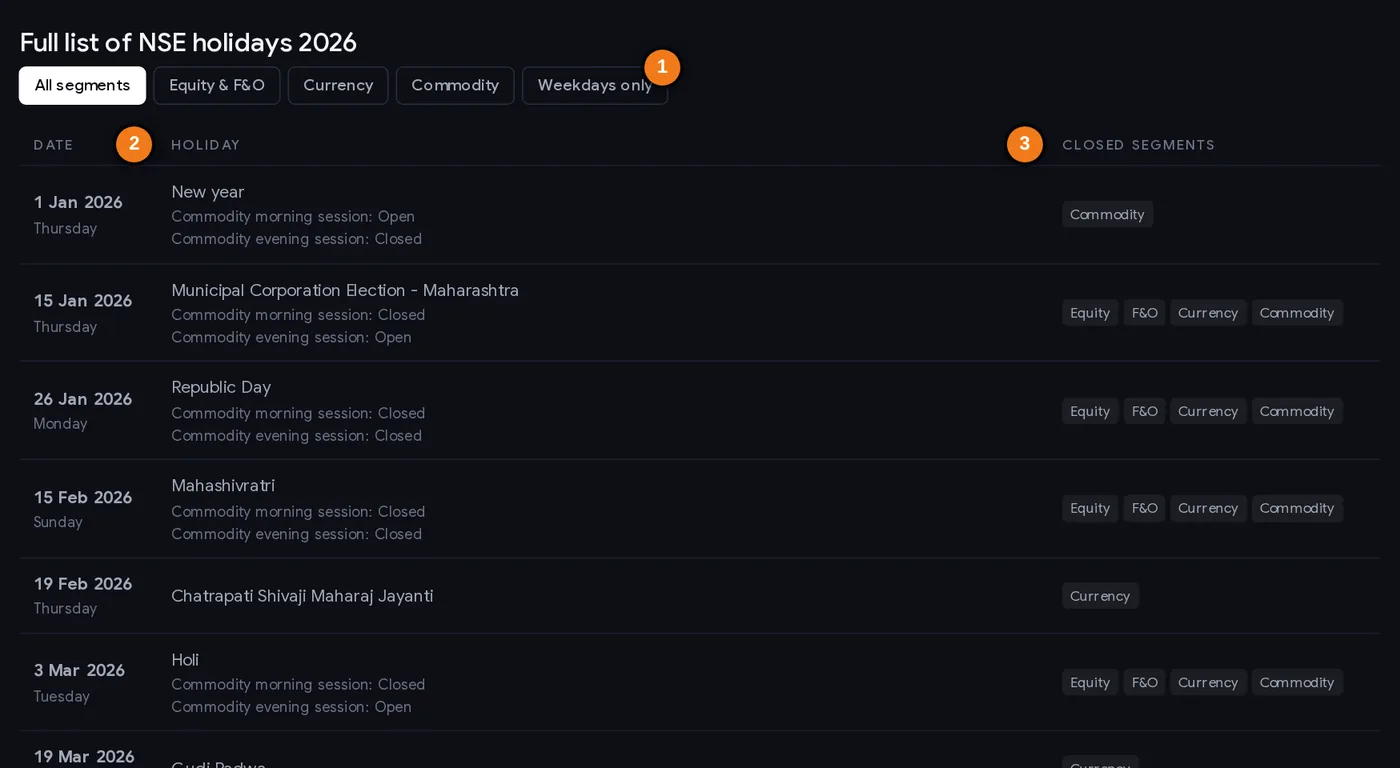
- 1Filter by segment, or weekdays only
- 2Holiday name, with commodity session notes
- 3Which segments are closed
The full list shows each holiday with its date, day, name, the commodity session notes and the segments that are closed. Use the buttons to see only equity and F&O, currency or commodity holidays, or only those on weekdays.
Step by step: using the holiday calendar
- At the start of each month, open the calendar and mark that month’s holidays in your trading diary.
- Check each holiday week for expiry changes on the expiry calendar, especially Tuesday holidays for NIFTY options.
- Before a long weekend, review open positions. Decide whether you are comfortable carrying them through two or three days of news.
- For delivery trades and dividends, count working days, not calendar days, when you work out settlement and ex-date eligibility.
- Around Diwali, look up the Muhurat session timing in the NSE circular, and be careful with indicators on that day.
- If you trade currency or commodity, filter the list to your segment; its holidays can differ.
Two playbooks
Playbook A: the long-weekend check (positional traders)
On the last trading day before a long weekend, list every open position with its stop loss. Ask: if the market opens 1–2% against me on Tuesday, what do I lose? If the answer is more than you planned, reduce size before the close. Option buyers should remember that options lose time value over the weekend and the holiday too, even though nothing trades.
Playbook B: the expiry-week adjustment (F&O traders)
In weeks with a Tuesday holiday, NIFTY options expire on Monday. Plan entries and exits one day earlier, expect expiry-day behaviour on the Monday, and use the option payoff calculator with the correct expiry date. Size every trade from your maximum loss with the position size calculator.
Case studies: how 2026 holidays changed real trading weeks
1. Diwali week, November 2026
This one week shows almost every holiday effect at once. Sunday 8 Nov was the Diwali Laxmi Pujan holiday with a Muhurat session; NIFTY closed 0.18% lower than on Friday 6 Nov. Monday 9 Nov became the NIFTY weekly expiry, because Tuesday 10 Nov (Diwali Balipratipada) was a holiday. The corporate actions calendar jumped straight from Monday 9 Nov to Wednesday 11 Nov, since no ex-date can fall on a closed day. And the board meetings calendar still listed 25 company board meetings on the 10 Nov holiday: their results could only be traded on Wednesday.
2. Dussehra week, October 2026
Tuesday 20 Oct was Dussehra, so the NIFTY weekly expiry moved to Monday 19 Oct. The same Monday was also the first session after a busy Saturday of bank results: Axis Bank and HDFC Bank had published on Saturday 17 Oct, and on Monday they fell 4.19% and 2.31%. Expiry, weekend results and a holiday the next day all landed on one session.
3. The Budget on a Sunday, 1 Feb 2026
The Union Budget was presented on a Sunday, and the exchanges held a full special session. NIFTY closed 1.96% lower than its Friday close. A trader who assumed the market would stay shut until Monday could have been caught holding positions through a live, falling session without watching it. Lesson: special sessions count as real trading days for prices, stop losses and margin, so read the exchange circulars in the weeks before big events.
4. An election holiday, 15 Jan 2026
Thursday 15 Jan was a holiday for the Maharashtra municipal corporation elections. Holidays like this are tied to election dates and can be added to the calendar during the year, which is why you should check the latest circular rather than a list printed at the start of the year.
5. Settlement across a holiday
Shares bought on Monday 9 Nov 2026 settle on the next working day. Because 10 Nov was a holiday, that was Wednesday 11 Nov. The same logic decides dividend eligibility: to receive a dividend with a Wednesday 11 Nov ex-date, you had to buy by Monday 9 Nov.
Common mistakes
- Forgetting that expiry moved. Six NIFTY weekly expiries in 2026 moved from Tuesday to Monday because of holidays.
- Counting calendar days for T+1. Settlement is the next working day.
- Assuming all segments close together. Currency closes on extra bank holidays; commodity often trades in the evening.
- Trusting Muhurat-day signals. One hour of trading gives misleading ranges, volumes and pivots.
- Using an old holiday list. Election holidays can be added during the year (15 Jan 2026 was one).
- Holding oversized positions into a long weekend.
Holiday checklist
- I know this month’s market holidays.
- I have checked whether any expiry I trade has moved.
- I have reviewed open positions before each long weekend.
- I count working days for settlement and ex-dates.
- I know my segment’s own holidays (currency, commodity).
- Around Diwali, I have checked the Muhurat timing and will treat that day’s data with care.
Glossary
| Trading holiday | A weekday on which the exchange is closed. |
| Segment | A part of the market: equity (cash), F&O, currency, commodity. |
| Muhurat trading | A short special session on Diwali to mark the new Samvat year. |
| Samvat | The Hindu calendar year that traditionally begins at Diwali. |
| Special session | A trading session on a non-trading day, e.g. Budget day on a Sunday. |
| Expiry day | The last trading day of an F&O contract; moves earlier when it falls on a holiday. |
| T+1 settlement | Trades settle on the next working day. |
| Long weekend | A holiday on a Monday or Friday next to the weekend. |
Questions
How many stock market holidays are there in 2026?
NSE has 20 equity and F&O holidays in 2026. Sixteen fall on weekdays; the other four fall on a Saturday or Sunday. Currency and commodity segments have a few extra or different days.
Is the stock market open on Diwali 2026?
The market is closed for Diwali Laxmi Pujan (Sunday 8 Nov 2026) and Diwali Balipratipada (Tuesday 10 Nov 2026), but the exchanges held a special Muhurat trading session on 8 Nov. The timing is announced in an exchange circular each year.
What is Muhurat trading?
A special session of about one hour held on Diwali to mark the start of the new Samvat year. Many investors buy a token amount of shares. Trading is thin, and NIFTY’s moves in the session have been small: between −0.18% and +0.88% in 2021–2026.
Are F&O and equity holidays the same?
Yes. Equity and F&O follow the same trading holidays. The currency segment has extra bank holidays, and the commodity segment often trades in the evening session on equity holidays.
What happens to F&O expiry if it falls on a holiday?
The contract expires on the previous trading day. In 2026 NIFTY weekly expiries moved from Tuesday to Monday in six holiday weeks, including 9 Nov for the Diwali Balipratipada holiday on 10 Nov.
Which are the long weekends for the stock market in 2026?
Holidays on a Monday or Friday: 26 Jan, 3 Apr, 1 May, 26 Jun, 14 Sep, 2 Oct and 25 Dec 2026.