
☰ All tutorials
Start here
Tool tutorialsHow to trade with ChartMineStocks
Stock monitorMy watchlistStock scores & checklistMarket & sectors
Nifty 50Bank NiftySensexFin NiftyDaily market reportMarket breadthSector rotationSector heatmapStock screenerRelative strength (RS)MCX commodity pricesFear & Greed IndexWhat happens after…Scanners
Top gainers & losersStocks to watch tomorrowNR7 stocks scannerInside bar stocks52-week high stocksGap up & gap down stocksRSI oversold stocksGolden cross stocksSuperTrend buy stocksScan builderEMA 9/21 crossoverMACD crossoverADX strong trendBollinger breakout / squeezeVolume spike stocksOpen = high / open = lowCandlestick pattern scannerNarrow CPR scannerF&O data
F&O ban listOI build-upOption chainPCR & max painExpiry calendarF&O lot sizesOI build-up heatmapPCR trendMax pain trendFutures basisStock screens
Quarterly growersProfit growth stocksLow P/E stocksMutual fund buyingNear 52-week low, growingDebt-free companiesHigh ROE & ROCEMagic Formula stocksLow price-to-bookSmart money
FII / DII dataShareholding changesBig-money footprintShort selling dataF&O positions by participantBulk & block dealsPromoter buyingDelivery percentageCalendars
Results calendarQuarterly results trackerBoard meetingsCorporate actionsIPO calendarIPO performanceResearch & planning
Strategy testerCompare stocksDividend yield stocksASM / GSM listExpiry-day movesSeasonality & stock historyNSE holidays 2026Position size calculatorOption payoff calculatorPivot point calculatorMore
Stock scanners hubStock screensHow to use the F&O lot size table
A plain-language guide to F&O lot sizes: why futures and options trade in lots, contract value and P&L per point with real 6 Nov 2026 prices, margin versus risk, a tour of the lot size table and the 35 changes due from January 2027.
What a lot size is, in plain words
In the cash market you can buy a single share. In the F&O segment (futures and options) you cannot: contracts are traded only in fixed bundles called lots. The lot size is the number of shares (or index units) in one contract.
- One NIFTY lot is 65 units of the index.
- One SBI lot is 750 shares; one Reliance lot is 500 shares.
Whatever you trade, futures or options, you buy or sell whole lots: 1 lot, 2 lots, 10 lots, never half a lot. So the lot size decides the smallest position you can take, how much one point of movement is worth to you, and how much money your broker will block.
One line to remember: profit or loss = price move × lot size × number of lots. A 444-point NIFTY move on one lot of 65 is ₹28,886, gained or lost in one day (that really happened on 6 Nov 2026).
The F&O lot sizes page lists the lot size of every NSE index and stock in F&O for each contract month currently listed, straight from NSE’s official lot-size file, and highlights the ones that are about to change.
Contract value: what one lot is really worth
The contract value (or notional value) of one lot is simply lot size × price. It is the size of the position you control, even though you only put up a margin.
| Contract | Lot size (Nov-26) | Close on 6 Nov 2026 | Value of one lot |
|---|---|---|---|
| NIFTY | 65 | 25,030.35 | ₹16.27 lakh |
| BANK NIFTY | 30 | 59,086.00 | ₹17.73 lakh |
| FIN NIFTY | 60 | 27,283.95 | ₹16.37 lakh |
| MIDCAP NIFTY | 120 | 14,008.80 | ₹16.81 lakh |
| ICICI Bank | 700 | ₹1,571.20 | ₹11.00 lakh |
| SBI | 750 | ₹1,018.50 | ₹7.64 lakh |
| Page Industries | 20 | ₹35,930.00 | ₹7.19 lakh |
| Reliance | 500 | ₹1,320.00 | ₹6.60 lakh |
| TCS | 225 | ₹2,498.50 | ₹5.62 lakh |
Across all 218 stocks with a lot size and a price on 6 Nov 2026, one lot ranged from about ₹3.0 lakh (Vedanta) to ₹13.0 lakh (Paytm), with a median of about ₹6.3 lakh. Index lots were all around ₹16–18 lakh.
Why the numbers look like this
SEBI’s rules set a minimum size for derivative contracts so that they are not too small, and the exchange picks lot sizes to keep contract values in the required range. For index derivatives, SEBI’s framework from November 2024 requires a contract value of at least ₹15 lakh when the lot size is set, which is why NIFTY, BANK NIFTY and the others all sit a little above ₹15 lakh. As prices move, the exchange reviews lot sizes and announces changes in advance.
What a lot size means for your money
Value of one point
| Contract | A move of… | …is worth, per lot |
|---|---|---|
| NIFTY (65) | 1 point | ₹65 |
| BANK NIFTY (30) | 1 point | ₹30 |
| SBI (750) | ₹1 | ₹750 |
| Reliance (500) | ₹1 | ₹500 |
Real examples from 6 Nov 2026
- NIFTY futures closed at 25,032.4, up 444.4 points from 24,588.0. On one lot: 444.4 × 65 = ₹28,886. A trader short one lot lost the same amount.
- SBI rose ₹12.10 (₹1,006.40 to ₹1,018.50). On one futures lot: 12.10 × 750 = ₹9,075.
- Options: the NIFTY 25,000 call for the 9 Nov expiry closed at ₹169.40. One lot cost 169.40 × 65 = ₹11,011 in premium; that is the most an option buyer can lose on it.
Margin is not the risk
To hold a futures position or to sell options, your broker blocks a margin, which is only a fraction of the contract value. The margin is a deposit, not the limit of your loss: in futures you can lose more than the margin if the price moves far enough. Margins change every day with volatility; check your broker’s margin calculator for the current figure. Always size positions on the contract value and your stop loss, not on the margin.
Why the lot size page helps: advantages and limits
✅ Official numbers
Straight from NSE’s lot-size file, for every contract month currently listed.
✅ Changes flagged early
Upcoming changes are highlighted, so you are not surprised when you roll into a month with a different lot.
✅ All 224 symbols
Five indices and every F&O stock on one searchable page.
✅ The base for every calculation
Lot size feeds position sizing, P&L per point, option premium per lot and margin.
The limits
- No prices or margins. The page lists lot sizes only. Multiply by the current price for the contract value, and check margin with your broker.
- Future months can change. The exchange can revise lot sizes; a month listed today may change in a later file. Check again before rolling.
- One lot can be too big for a small account. If a single lot of a stock moves more than you can afford to lose in a normal day, that contract is simply too large for your capital, however attractive the idea.
How to use it: as the first step of every F&O trade plan. Lot size × price gives the real size of the position; lot size × your stop distance gives your rupee risk. If that risk is too big, trade fewer lots, a smaller contract, or the cash market.
A tour of the lot size page
Open F&O lot sizes. There is one table, a search box and four filter buttons.
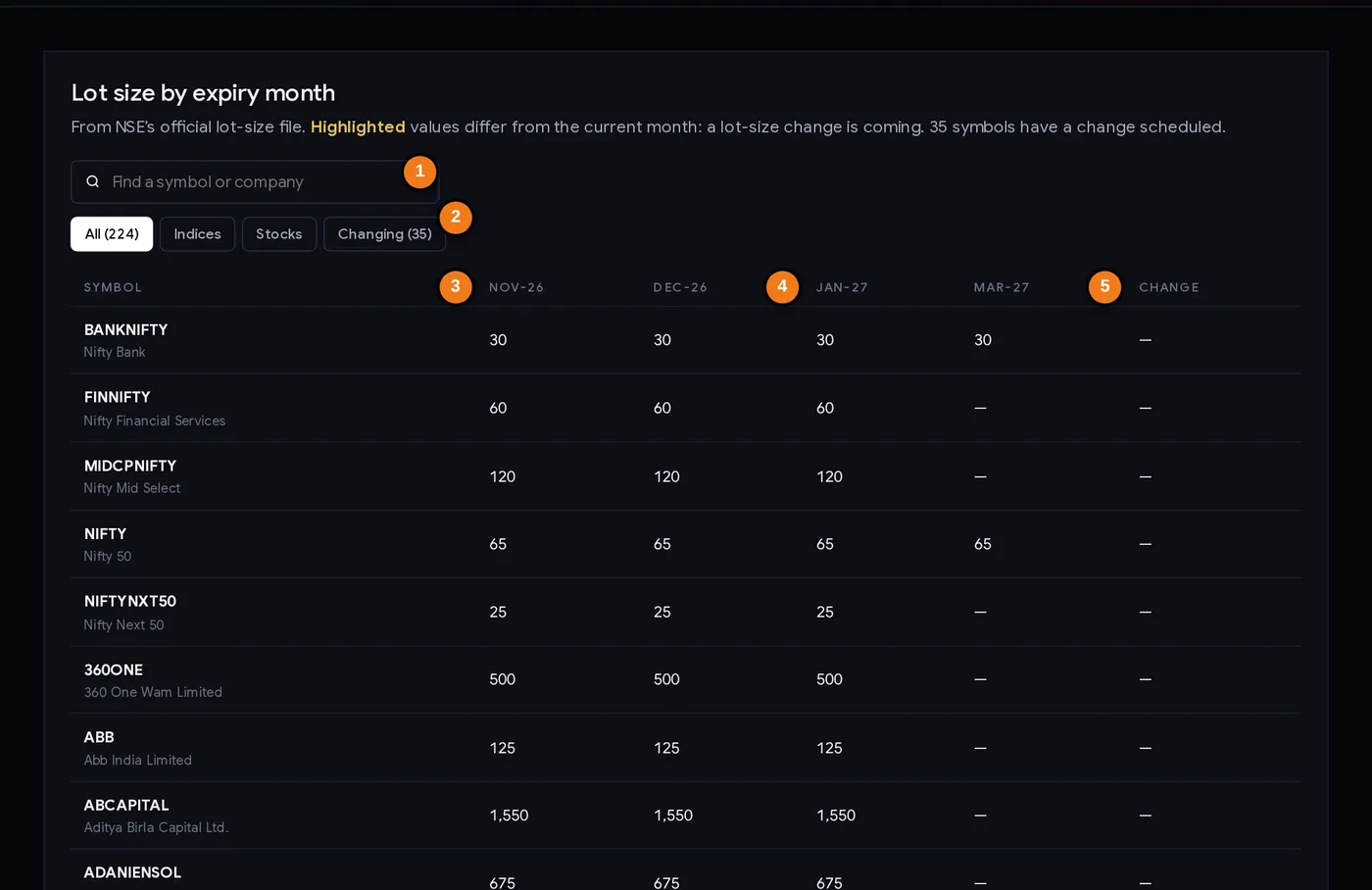
- 1Find a symbol or company
- 2Show only symbols with a scheduled change
- 3Current month’s lot size
- 4A later month: check before rolling
- 5Flags a scheduled change
The controls and columns
| Part | What it tells you |
|---|---|
| Find a symbol or company | Type “sbin” or “state bank” to jump to it. |
| All / Indices / Stocks / Changing | Filter the table. Changing (35) lists only the symbols whose lot size differs in a later month. |
| Symbol | NSE symbol with the company or index name under it. |
| Nov-26, Dec-26, Jan-27 | The lot size for contracts expiring in each month. The first column is the current month. |
| Mar-27 | A longer-dated month listed for some indices (NIFTY, BANK NIFTY). “—” means no contract for that month. |
| Change | “Changes” when a later month has a different lot size than the current month. |
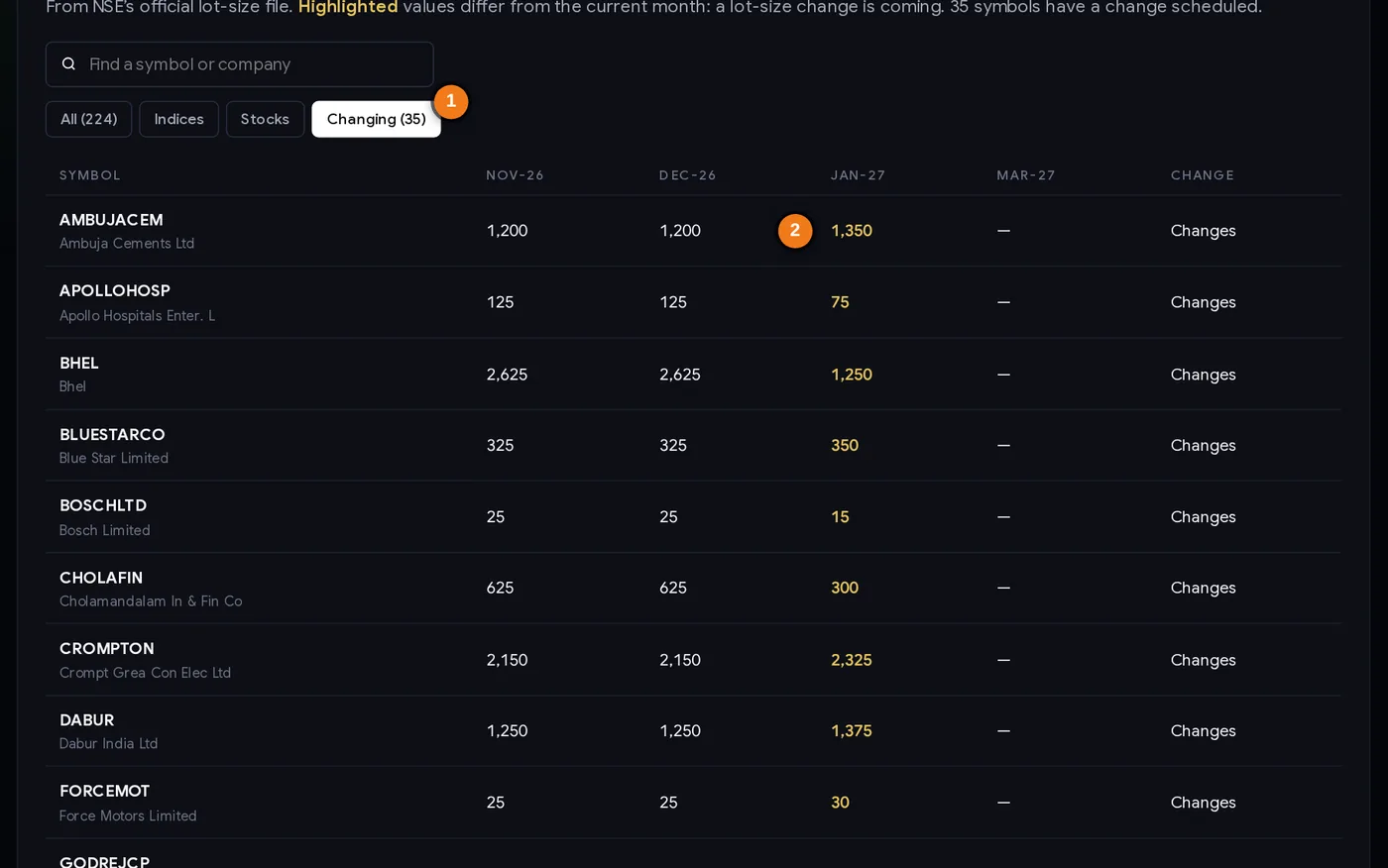
- 1The Changing filter
- 2Highlighted: the new lot size and the month it starts
With Changing selected, the table shows only the 35 symbols with a scheduled change. The highlighted (yellow) number is the new lot size, in the month it takes effect. In this file every change starts with the Jan-27 contracts; the Nov-26 and Dec-26 contracts keep their current lot sizes.
Step by step: checking lot size before a trade
- Find the symbol on the lot size page and read the lot for the month you will trade, not just the current month.
- Work out the contract value: lot size × current price. Is one lot a sensible size for your account?
- Work out your rupee risk: distance to your stop × lot size × number of lots. For example, a ₹15 stop on one SBI lot is 15 × 750 = ₹11,250.
- Compare with your risk limit (for example 0.5% to 1% of capital per trade). If it is too much, reduce lots or skip the trade. The position size calculator does this for you.
- For options, premium × lot size is your cost (and maximum loss as a buyer). Model sold options in the option payoff calculator.
- Check the Change column if you plan to roll into a later month.
- Check the expiry date of the month in the expiry calendar.
Three ways traders use lot sizes
Playbook A: size from risk, not from margin
Start with how much you are willing to lose on the trade. Divide by (stop distance × lot size) to get the number of lots, and round down. If the answer is less than one lot, the trade is too big for your account with that stop: widen nothing, simply skip it or use the cash market.
Playbook B: plan rollovers around lot changes
When a lot size changes, the old and new months have different quantities. If you hold 2 lots of BHEL in Dec-26 (2 × 2,625 = 5,250 shares) and roll into Jan-27, 2 lots there is only 2,500 shares; you would need 4 lots (5,000 shares) to keep roughly the same exposure. Check the numbers before rolling.
Playbook C: choose the right contract for your capital
Index lots are about ₹16–18 lakh. Some stock lots are around ₹3–5 lakh. If index futures are too large for your account, they are too large; a smaller contract, defined-risk option spreads, or the cash market may fit better. Bigger leverage is not a reason in itself.
A simple rule many traders use: the loss at your stop, for the whole position, should be a small, fixed share of your capital. The lot size is just the unit you count in.
Case studies: the January 2027 lot changes
NSE’s current file schedules 35 lot-size changes, all from the Jan-27 contracts. Values below use 6 Nov 2026 closing prices.
1. BHEL: lot more than halved after a big rise
BHEL’s lot changes from 2,625 to 1,250 shares. The share had risen from ₹262.70 on 30 Jan 2026 to ₹418.80 on 6 Nov, about +59%. At ₹418.80, one current lot is worth ₹10.99 lakh; one Jan-27 lot will be ₹5.24 lakh. Anyone rolling BHEL futures needs to double the number of lots to keep the same number of shares.
2. Paytm: the biggest lot on the list, cut to less than half
Paytm (One 97 Communications) had the largest contract value of any F&O stock on 6 Nov: 725 × ₹1,794.40 = ₹13.01 lakh. The share had climbed from ₹1,137.50 on 30 Jan 2026. From Jan-27 its lot becomes 325 shares, about ₹5.83 lakh.
3. Vedanta and Infosys: lots go up after prices fell
Vedanta had the smallest contract value on 6 Nov: 1,150 × ₹261.75 = ₹3.01 lakh (the share was ₹681.55 on 30 Jan 2026). Its lot rises to 1,975, about ₹5.17 lakh. Infosys fell from ₹1,641.00 (30 Jan) to ₹1,181.40, and its lot rises from 400 to 500 (₹4.73 lakh to ₹5.91 lakh).
4. The pattern, and an exception
Across all 35 changes, the new Jan-27 lots are worth between ₹3.7 lakh and ₹7.6 lakh at 6 Nov prices, with a median of about ₹5.3 lakh: lots shrink where prices rose and grow where prices fell. Not every change follows the recent price, though. Vodafone Idea’s lot halves from 71,475 to 36,125 shares although its price barely moved this year (₹11.17 on 30 Jan, ₹12.76 on 6 Nov). The exchange’s review uses its own data and dates, so always read the file rather than guessing.
Common mistakes
- Sizing on margin instead of contract value. A ₹16 lakh NIFTY lot can move ₹28,886 in a day.
- Using last month’s lot size after a change, and ending up with double or half the intended position.
- Thinking an option’s price is per lot. The quoted premium is per unit; multiply by the lot size.
- Trading a contract that is too big for your account because the margin looked affordable.
- Ignoring physical settlement: holding stock F&O into expiry can mean taking or giving delivery of a full lot of shares.
- Forgetting that NIFTY’s lot and BANK NIFTY’s lot are different (65 and 30), so a point means different rupees.
Checklist before placing an F&O order
- I have the lot size for the exact contract month I am trading.
- I know the contract value (lot size × price) and it suits my account.
- My rupee risk = stop distance × lot size × lots, and it is within my limit.
- For options, I know the premium per lot and my maximum loss.
- I have checked the margin with my broker, and I know margin is not the limit of my loss.
- If rolling, I have checked for a lot-size change and adjusted the number of lots.
- I know the expiry date, and I will not drift into physical settlement by accident.
- The order quantity is a whole number of lots.
Glossary
| Lot size | The number of shares or index units in one F&O contract. |
| Contract value | Lot size × price: the size of the position one lot controls. |
| Margin | The deposit your broker blocks to hold a futures position or a sold option; a fraction of contract value. |
| Premium | The price of an option, quoted per unit. |
| Point value | What a one-point (or ₹1) move is worth on one lot; equal to the lot size. |
| Contract month | The month in which a contract expires, e.g. Jan-27. |
| Lot-size revision | An exchange change to a symbol’s lot size, applied from a named contract month. |
| Rollover | Closing a position in the expiring month and opening it in the next. |
| Physical settlement | Stock F&O held to expiry is settled by delivery of shares. |
Questions
What is the NIFTY lot size now?
65 for the Nov-26, Dec-26, Jan-27 and Mar-27 contracts, from NSE’s lot-size file as shown on 9 Nov 2026. At NIFTY’s 6 Nov close of 25,030.35, one lot was worth about ₹16.27 lakh.
What is the BANK NIFTY lot size?
30 for every listed month as of 9 Nov 2026. At 59,086 on 6 Nov 2026, one lot was worth about ₹17.73 lakh.
How do I calculate F&O contract value?
Contract value = lot size × price. For example, SBI’s lot of 750 at ₹1,018.50 is about ₹7.64 lakh.
Why do F&O lot sizes change?
The exchange reviews lot sizes so that contract values stay within the range SEBI requires as prices move. Changes apply from a named contract month; months already trading keep their lot size.
Which stocks have a lot size change coming?
The Changing filter on the lot size page lists them. As of 9 Nov 2026, 35 symbols had changes starting with the Jan-27 contracts, including BHEL (2,625 to 1,250), Paytm (725 to 325) and HDFC Bank (650 to 750).
How much money do I need to trade one NIFTY lot?
Your broker blocks a margin that is a fraction of the roughly ₹16 lakh contract value, and it changes daily. More important is the risk: a 100-point NIFTY move is ₹6,500 per lot, and moves of several hundred points in a day happen.