
☰ All tutorials
Start here
Tool tutorialsHow to trade with ChartMineStocks
Stock monitorMy watchlistStock scores & checklistMarket & sectors
Nifty 50Bank NiftySensexFin NiftyDaily market reportMarket breadthSector rotationSector heatmapStock screenerRelative strength (RS)MCX commodity pricesFear & Greed IndexWhat happens after…Scanners
Top gainers & losersStocks to watch tomorrowNR7 stocks scannerInside bar stocks52-week high stocksGap up & gap down stocksRSI oversold stocksGolden cross stocksSuperTrend buy stocksScan builderEMA 9/21 crossoverMACD crossoverADX strong trendBollinger breakout / squeezeVolume spike stocksOpen = high / open = lowCandlestick pattern scannerNarrow CPR scannerF&O data
F&O ban listOI build-upOption chainPCR & max painExpiry calendarF&O lot sizesOI build-up heatmapPCR trendMax pain trendFutures basisStock screens
Quarterly growersProfit growth stocksLow P/E stocksMutual fund buyingNear 52-week low, growingDebt-free companiesHigh ROE & ROCEMagic Formula stocksLow price-to-bookSmart money
FII / DII dataShareholding changesBig-money footprintShort selling dataF&O positions by participantBulk & block dealsPromoter buyingDelivery percentageCalendars
Results calendarQuarterly results trackerBoard meetingsCorporate actionsIPO calendarIPO performanceResearch & planning
Strategy testerCompare stocksDividend yield stocksASM / GSM listExpiry-day movesSeasonality & stock historyNSE holidays 2026Position size calculatorOption payoff calculatorPivot point calculatorMore
Stock scanners hubStock screensHow to use the low price-to-book screen
A plain-language tutorial on stocks trading below book value: what book value and P/B mean, the exact rules behind the list, why banks and PSUs dominate it, how ROE decides whether below-book is cheap, and real case studies from 2026.
What book value and P/B mean, in plain words
Every company keeps accounts. If you add up everything it owns (factories, loans given, cash, stock in the warehouse) and subtract everything it owes, what is left belongs to the shareholders. That leftover is the book value, also called shareholders’ equity or net worth.
Divide the book value by the number of shares and you get book value per share (BVPS): the accounting value behind each share. Then compare it with the share price:
P/B (price-to-book) = share price ÷ book value per share. A P/B of 1 means the market values the company at exactly its accounting net worth. A P/B of 0.7 means you pay ₹70 for ₹100 of book value. A P/B of 8 means you pay ₹800.
The Low price-to-book screen lists NSE stocks priced below their book value (P/B under 1) that are still earning a return on equity (ROE) of 10% or more over the last four quarters. Unlike ChartMine’s other balance-sheet screens, it includes banks and NBFCs, because P/B is the most common way to value them.
Why the ROE rule? A company below book value that loses money may deserve its low price. One that still earns 10% or more on its equity is more interesting: the market is pricing it as if its net worth were overstated or its profits about to fall. Sometimes it is right; sometimes it is too gloomy.
The exact rules, and a worked example
| Rule | What it means |
|---|---|
| P/B under 1 | Last close ÷ book value per share is below 1. Book value is shareholders’ equity at the latest balance sheet (consolidated where the company reports consolidated results) divided by shares outstanding. |
| ROE 10% or more | Profit belonging to shareholders over the last four quarters ÷ average equity (latest balance sheet and the one about 12 months earlier). |
| Banks and NBFCs included | For banks, equity = paid-up capital + reserves, as reported in the bank’s filing format. |
| Sanity checks | P/B values outside 0.05–300 are treated as data errors and dropped. Companies that recently demerged a business are skipped, because their book value and results do not yet match. If one of the last four quarters’ profit is more than three times the median of the four, the stock is left out. |
| Size and liquidity | Market cap of at least ₹500 crore, enough trading history and turnover. |
| Sort | Lowest P/B first. |
Worked example: Bank of Baroda (balance sheet at 30 Sep 2026)
- Shareholders’ equity: capital ₹1,036 crore + reserves ₹1,73,746 crore = ₹1,74,781 crore.
- Shares outstanding: about 517.8 crore.
- Book value per share = 1,74,781 crore ÷ 517.8 crore = ₹337.57.
- Share price on 6 Nov 2026: ₹250.31. P/B = 250.31 ÷ 337.57 = 0.74.
- Profit of the last four quarters: ₹19,267 crore. Average equity: (1,74,781 + 1,60,250) ÷ 2 = ₹1,67,516 crore. ROE = 11.5%.
So on 6 Nov 2026 the market valued Bank of Baroda at about three-quarters of its accounting net worth, while it earned 11.5% on that net worth. Both rules pass.
Types of low-P/B stocks, and what “book” really means for each
Book value is an accounting number. How much you can trust it depends on what the company owns. That is why the same P/B of 0.7 can mean very different things.
| Type | What the book value is made of | Main question |
|---|---|---|
| PSU and private banks | Mostly loans given to borrowers. | Will those loans be repaid? Bad loans (NPAs) can wipe out book value. A bank with high bad loans often trades below book for years. |
| NBFCs and housing finance companies | Loans, often to one segment (homes, vehicles, microfinance). | Loan quality, and the cost and availability of their own borrowing. |
| Government-owned energy and commodity companies | Refineries, oil fields, plants, often at old historical cost. | Are profits steady or tied to a commodity price? Is there government control over prices or dividends? |
| Industrial and infrastructure companies | Plants, projects, money owed by customers (often government). | Will receivables be collected? Are projects profitable? |
| Holding companies | Stakes in other companies. | Markets usually value holding companies at a discount to their parts. |
The link between ROE and P/B
A useful rule of thumb: a company that earns on its book value about what investors want as a return deserves a P/B near 1. One that earns more deserves more than 1; one that earns less deserves less. If investors want, say, 12–13% from a bank and the bank earns 11.5%, a P/B a little under 1 is not obviously “cheap”: it may be roughly fair. Below book is a bargain only if the ROE is likely to rise, or the market is wrongly doubting the book value.
Advantages and limits (with a short test)
✅ Classic value
Buying assets for less than their accounting value is one of the oldest value-investing ideas, going back to Benjamin Graham.
✅ Natural fit for banks
A bank’s assets are mostly loans and investments, close to their real value when loan quality is good, so P/B is meaningful.
✅ Profitability filter
The 10% ROE rule removes companies whose low price simply reflects losses.
✅ Short and focused
Only about 30 names qualify, so you can read about every one.
The limits
- Book value can be wrong. Bad loans not yet recognised, old plants that are worth less than their accounts say, or doubtful receivables all overstate book value.
- Cheap for a reason. Weak governance, government control, a shrinking industry or low ROE can keep a stock below book for many years.
- Sector bunching. The list is mostly PSU banks, finance companies and government energy companies. Owning all of them is a sector bet, not diversification.
- Balance sheets are filed only twice a year, so book value can be months old.
What happened in a five-month test
We rebuilt the list on 1 Jun 2026 using only data filed before that day, and checked prices on 6 Nov 2026 (price change only; dividends not included):
| Group | Stocks | Median change | Average | Share that rose |
|---|---|---|---|---|
| Low P/B list | 21 | −0.3% | 0.0% | 48% |
| Of which banks | 9 | +1.3% | +8.1% | 67% |
| All eligible stocks | 1,238 | −2.6% | +1.5% | 45% |
In plain words: the list’s median stock did a little better than the market’s, mainly thanks to banks, while its average was a little worse. With only 21 stocks and five months, this is not evidence of an edge either way. Individual results ranged from −37% to +41% (see the case studies). ChartMine’s balance-sheet history starts in 2025, so we could not test longer.
A tour of the screen
Open the Low price-to-book page.

- 1The rule: P/B under 1, ROE 10%+, banks and NBFCs included.
- 2How many stocks match.
- 3Date of the prices used.
- 4Fundamentals from each company’s latest filings.
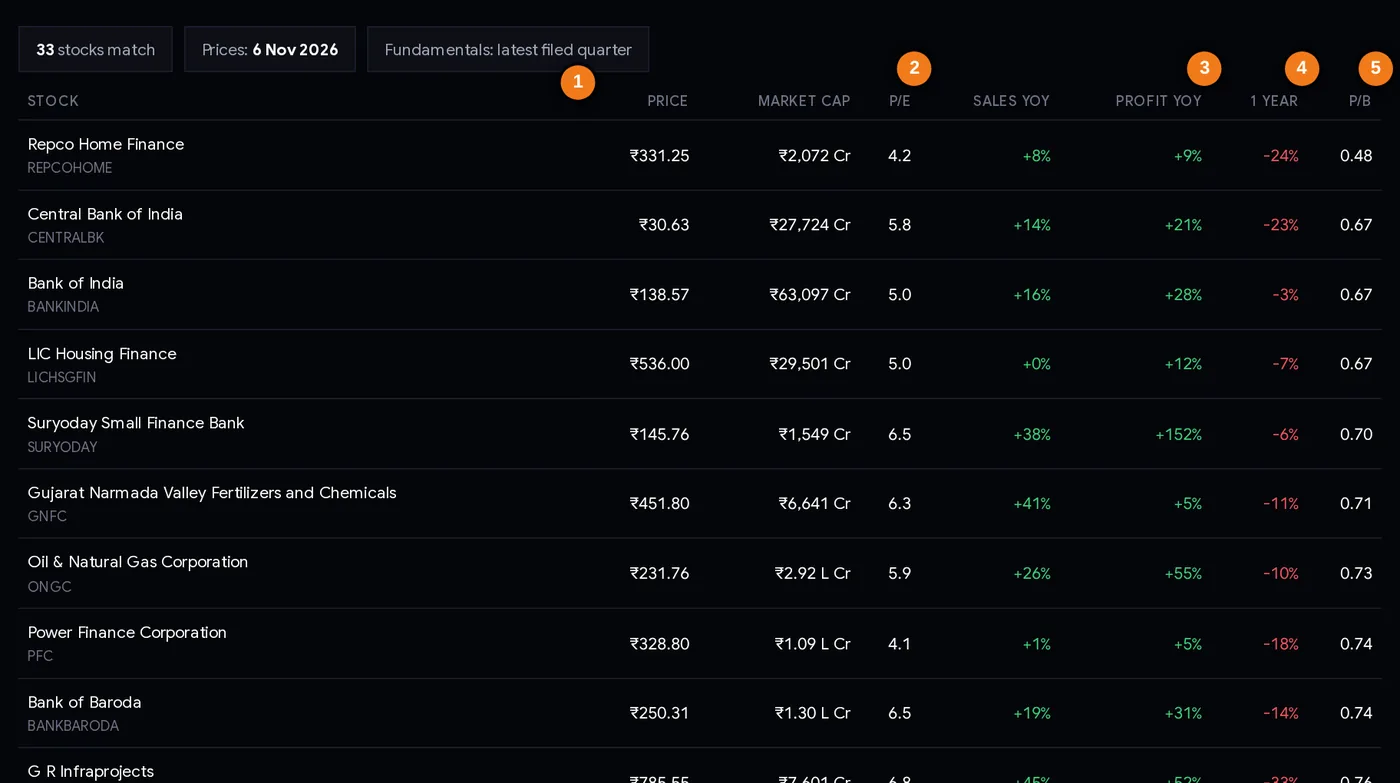
- 1Company and symbol (click for the stock page)
- 2P/E, last four quarters
- 3Profit growth on a year ago
- 4Share price change over one year
- 5P/B: price ÷ book value per share
Every column explained
| Column | What it tells you |
|---|---|
| Stock | Company and NSE symbol; click for the stock page. |
| Price / Market cap | Last close and market value in ₹ crore (“L Cr” = lakh crore). |
| P/E | Price ÷ earnings per share, last four quarters. Low-P/B stocks usually have low P/Es too (many between 4 and 8 on 6 Nov 2026). |
| Sales YoY | Latest quarter’s sales against a year earlier. For banks and NBFCs it is total income. |
| Profit YoY | Latest quarter’s profit against a year earlier. A dash means no comparable figure. |
| 1 year | Share price change over the last year. |
| P/B | Price ÷ book value per share. Sorted lowest first. |
For a bank, the stock page’s balance sheet section shows ROE, book value per share and the credit-deposit ratio, with equity, deposits, loans and borrowings over three dates:
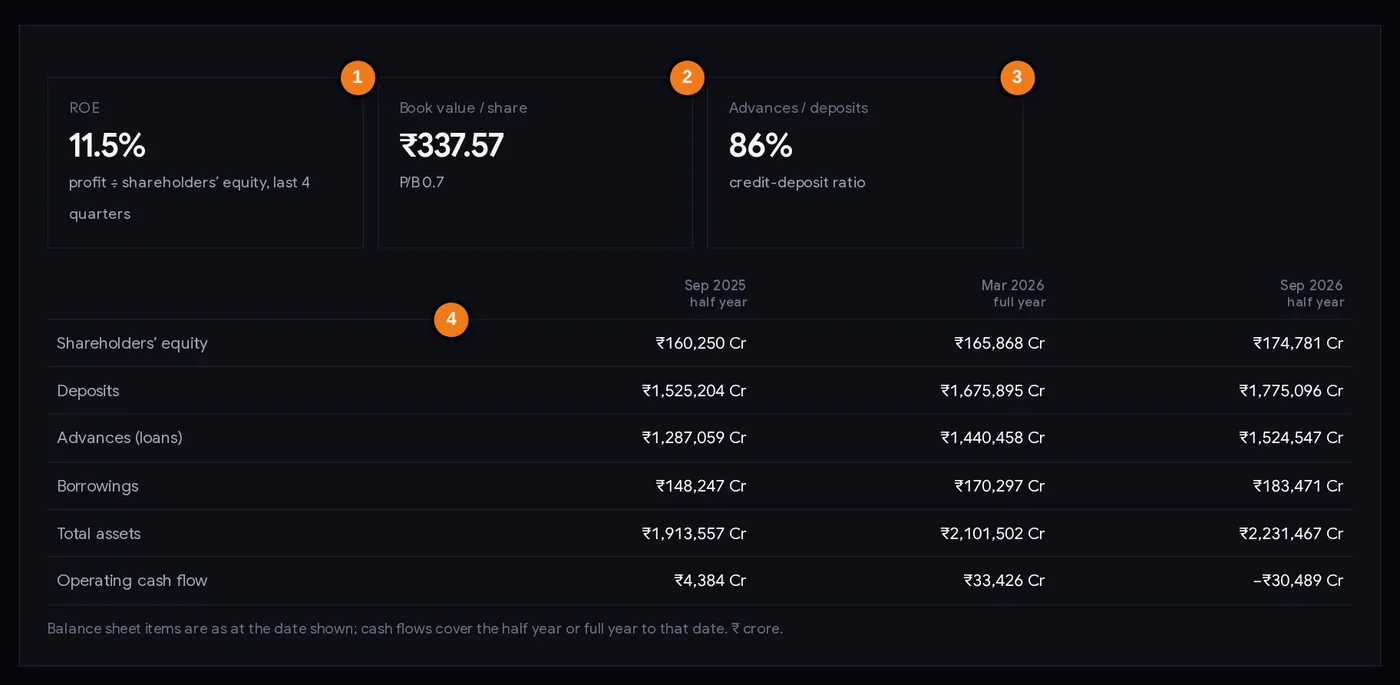
- 1ROE, last four quarters
- 2Book value per share and P/B
- 3Credit-deposit ratio (loans ÷ deposits)
- 4Shareholders’ equity at each date
Step by step: researching a below-book stock
- Open the list and note the price date and count.
- Group the names by type (bank, NBFC, PSU energy, industrial). Compare like with like: a bank at 0.7 and a refiner at 0.7 are different stories.
- Ask why it is below book. For lenders: loan quality and recent bad-loan trends. For industrials: debts, receivables, the industry cycle.
- Check the ROE trend. Is it rising towards the level investors expect (often 12–15%) or falling? Rising ROE is what usually lifts P/B.
- Check book value growth on the stock page: is equity growing every half year, or shrinking?
- Check ownership. Government ownership, promoter pledges and recent mutual fund or FII changes all matter.
- Compare with peers using Compare stocks: a bank at 0.7 when its peers are at 1.5 is a bigger question than one at 0.7 when peers are at 0.8.
- Decide size and exit rules before buying. Low-P/B stocks can stay low for years.
Three ways investors use this list
Playbook A: the improving-lender watch
Many value investors watch below-book banks and NBFCs for signs of improving ROE: falling bad loans, rising profit, growing book value. The idea is that if ROE rises from, say, 10% to 14%, the market may eventually pay book value or more. They buy in parts and judge progress every results season.
Playbook B: the asset-backed basket
Instead of picking one name, some investors hold a small, equal-weighted group of below-book companies from different sectors, so that one bad surprise does not dominate. Combining with the debt-free screen (for non-financial companies) reduces the chance that the book value is eaten by debt.
Playbook C: the trap filter
Use the list to avoid mistakes as much as to find ideas. If a stock is below book, ROE is barely above 10%, profit is falling and funds are selling, the low price may be justified. Cross-check with the low P/E with growth screen: names on both lists with growing sales and profit are the stronger candidates.
Below book is not a floor. A stock at 0.7× book can fall to 0.4× (Repco Home Finance went from 0.59× on 1 Jun 2026 to 0.48× on 6 Nov 2026). Keep each position small, spread across sectors, and decide in advance what would make you exit.
Case studies from 2026
1. Repco Home Finance: cheaper, and then cheaper again
On 1 Jun 2026 our rebuilt list had Repco Home Finance at a P/B of 0.59 with ROE above 10%. By 6 Nov 2026 the price had fallen from ₹380.45 to ₹331.25 (−12.9%), and its P/B was 0.48, the lowest on the live list, with book value per share of ₹684.29, ROE of 12.0% and a P/E of 4.2. Its income was up 8% and profit up 9% on a year earlier. Lesson: a low P/B with steady profits can still get lower. Being “right” about value can take a long time, if it happens at all.
2. South Indian Bank and PNC Infratech: the spread inside one list
Both were on the 1 Jun list. South Indian Bank, at P/B 0.94, rose from ₹41.06 to ₹57.75 by 6 Nov (+40.6%). PNC Infratech, at P/B 0.78, fell from ₹207.07 to ₹130.20 (−37.1%). Same rules, opposite results. Lesson: the screen finds candidates; the outcome depends on what happens to each business. That is why position size and diversification matter more than the list.
3. Bank of India and Central Bank of India: steady, not spectacular
Both PSU banks were near the top of the list on both dates. Bank of India: P/B 0.69 on 1 Jun, ₹136.74 to ₹138.57 by 6 Nov (+1.3%), ROE 13.7% and P/B 0.67 on 6 Nov. Central Bank of India: P/B 0.70 on 1 Jun, +1.1% by 6 Nov, P/B 0.67. Lesson: large PSU banks below book often move slowly; the market waits for proof that ROE will stay higher.
4. ONGC: a commodity company below book
ONGC was on the list at P/B 0.89 on 1 Jun and 0.73 on 6 Nov 2026 (P/E 5.9, sales up 26% and profit up 55% on a year earlier). Its price fell 12.3% between the two dates even as results grew. Its book value includes oil fields and refineries whose worth depends on crude prices and government policy. Lesson: for commodity companies, P/B tells you little without a view on the commodity cycle.
Common mistakes
- Thinking “below book” means “cannot fall”. Book value is an accounting estimate, not a floor.
- Ignoring loan quality in banks and NBFCs. Bad loans reduce book value directly.
- Comparing across sectors. A refiner, a bank and a builder at the same P/B are not equally cheap.
- Ignoring ROE. A P/B of 0.8 with 10% ROE may be fair; with 18% ROE it would be unusual.
- Buying the whole list. It is concentrated in PSU banks, finance companies and government energy companies.
- Impatience. Value can take years to be recognised, or never be.
Research checklist
- I know which type of company this is (bank, NBFC, PSU energy, industrial, holding).
- I have a reason to trust the book value (loan quality, asset values, receivables).
- ROE is stable or rising, comfortably above 10%.
- Book value per share has been growing.
- No large selling by funds or promoters; no governance red flags.
- Compared with peers’ P/B and ROE.
- Position small, sectors spread, exit rule written down.
Glossary
| Book value / net worth | Assets minus liabilities: the shareholders’ equity in the accounts. |
| Book value per share (BVPS) | Shareholders’ equity ÷ shares outstanding. |
| P/B | Share price ÷ BVPS. Under 1 = below book value. |
| ROE | Profit to shareholders over the last four quarters ÷ average equity. |
| NPA | Non-performing asset: a loan on which the borrower has stopped paying. |
| NBFC | Non-banking financial company: a lender that is not a bank (housing finance, vehicle loans, microfinance and others). |
| PSU | Public sector undertaking: a government-owned company. |
| Credit-deposit ratio | A bank’s loans ÷ its deposits. |
| Value trap | A stock that looks cheap but stays cheap or falls further because its business or book value is weaker than it seems. |
Questions
Which stocks are trading below book value in India?
ChartMine’s low price-to-book screen lists NSE stocks with a P/B under 1 and an ROE of 10% or more, including banks and NBFCs. On 6 Nov 2026 prices, 33 stocks matched, led by Repco Home Finance (0.48), Central Bank of India, Bank of India and LIC Housing Finance (0.67 each).
What does a P/B ratio below 1 mean?
The market values the company at less than its accounting net worth (shareholders’ equity). It can signal undervaluation, or that investors doubt the book value or expect weak returns.
Is a stock below book value a good buy?
Not automatically. Book value can overstate what assets are worth, and such stocks can stay cheap for years. In ChartMine’s five-month test (Jun to Nov 2026) the low P/B list did roughly in line with the market, with results ranging from −37% to +41%.
Why does the low P/B screen include banks?
P/B is the standard way to value banks and NBFCs, because their assets are mainly loans and investments carried close to their value. Other ChartMine balance-sheet screens exclude financial companies.
What is a good P/B ratio for banks?
It depends mainly on ROE and loan quality. Banks earning high, stable returns usually trade well above book value; banks with lower returns or more bad loans often trade below 1. Compare a bank with peers of similar ROE.