
☰ All tutorials
Start here
Tool tutorialsHow to trade with ChartMineStocks
Stock monitorMy watchlistStock scores & checklistMarket & sectors
Nifty 50Bank NiftySensexFin NiftyDaily market reportMarket breadthSector rotationSector heatmapStock screenerRelative strength (RS)MCX commodity pricesFear & Greed IndexWhat happens after…Scanners
Top gainers & losersStocks to watch tomorrowNR7 stocks scannerInside bar stocks52-week high stocksGap up & gap down stocksRSI oversold stocksGolden cross stocksSuperTrend buy stocksScan builderEMA 9/21 crossoverMACD crossoverADX strong trendBollinger breakout / squeezeVolume spike stocksOpen = high / open = lowCandlestick pattern scannerNarrow CPR scannerF&O data
F&O ban listOI build-upOption chainPCR & max painExpiry calendarF&O lot sizesOI build-up heatmapPCR trendMax pain trendFutures basisStock screens
Quarterly growersProfit growth stocksLow P/E stocksMutual fund buyingNear 52-week low, growingDebt-free companiesHigh ROE & ROCEMagic Formula stocksLow price-to-bookSmart money
FII / DII dataShareholding changesBig-money footprintShort selling dataF&O positions by participantBulk & block dealsPromoter buyingDelivery percentageCalendars
Results calendarQuarterly results trackerBoard meetingsCorporate actionsIPO calendarIPO performanceResearch & planning
Strategy testerCompare stocksDividend yield stocksASM / GSM listExpiry-day movesSeasonality & stock historyNSE holidays 2026Position size calculatorOption payoff calculatorPivot point calculatorMore
Stock scanners hubStock screensHow to use the board meetings calendar
A plain-language guide to company board meetings: what each purpose means, how to read the calendar and its filters, how meetings lead to results and ex-dates, and the mistakes to avoid.
What a board meeting is, and why the market cares
A company is run day to day by its managers, but the big decisions belong to its board of directors. Approving the quarterly results, declaring a dividend, giving bonus shares, splitting the shares, buying back shares or raising fresh money all need a board meeting.
Because these decisions can move the share price, SEBI’s listing rules make companies tell the stock exchange in advance when the board will meet and what it will discuss. These notices are public. The board meetings calendar collects every upcoming meeting that NSE companies have announced and lays them out by date and purpose.
On 9 Nov 2026 the calendar showed 620 upcoming meetings. Almost all of them (611) were to approve results for the July–September quarter, 18 had a dividend on the agenda, and a handful were about fund raising, buybacks, a bonus or a stock split.
One line to remember: a board meeting notice tells you when news is coming and what kind of news. It does not tell you what the decision will be. “To consider a buyback” is not the same as “buyback approved”.
The purposes you will see, and what each one means
| Purpose | What the board decides | Why it can move the price |
|---|---|---|
| Results | Approves the quarterly (or yearly) financial results, which are published right after the meeting. | The biggest scheduled event of the quarter for most stocks. |
| Dividend | Declares a cash payment per share (interim during the year, final after the year-end) and fixes a record date. | Sets the ex-date, when the share price drops by roughly the dividend. |
| Bonus | Free extra shares to existing holders, e.g. 1:1 = one new share for each held. | Price adjusts down in proportion; often seen as a sign of confidence. |
| Stock split | Divides each share into smaller ones of lower face value, e.g. ₹10 into five of ₹2. | Price adjusts in proportion; shares become cheaper to buy one at a time. |
| Buyback | The company offers to buy its own shares from holders, usually at a premium. | Returns cash to shareholders and reduces the number of shares. |
| Fund raising | Approves raising money through new shares, a QIP (sale to institutions), a rights issue or bonds. | New shares can dilute existing holders; debt adds interest costs. |
| Other business | Anything else: a special committee, a merger, an appointment. | Read the filing: it can be routine or important. |
A meeting often has several purposes. On 9 Nov 2026, 17 meetings combined results with a dividend (for example Cochin Shipyard and MRF on 10 Nov, Oil India and Page Industries on 12 Nov), 4 combined results with fund raising and 2 combined results with a stock split (Shiv Aum Steels on 13 Nov, Shreeji Shipping Global on 14 Nov).
Related rules worth knowing
- Advance notice. For results, SEBI’s rules ask for at least two working days’ notice; most companies give more.
- Trading window. Company insiders are not allowed to trade the shares around results, from the end of the quarter until shortly after the results are public.
- Outcome filing. After the meeting the company files the “outcome of board meeting” with the decisions. That filing, not the notice, is the news.
The timeline: from notice to money in your account
Every board decision follows the same path. Knowing it tells you which date matters for what.
- Notice (intimation). The company tells NSE the date and purpose of the meeting. This is what the calendar shows. Example from the list on 9 Nov 2026: Oil India, 12 Nov, “to consider and approve the financial results for the period ended September 30, 2026 and dividend”.
- Meeting day. The board meets, often in the afternoon. Results and decisions are filed with the exchange during or soon after the meeting.
- Outcome filing. The company publishes what was decided: the results, the dividend per share, the bonus ratio, the buyback price and size, and the record date.
- Price reaction. If the outcome came during market hours, the price reacts the same day. If it came after 3:30 PM, on a weekend or on a holiday, it reacts on the next trading day.
- Ex-date. For dividends, bonus issues and splits, the share starts trading without the entitlement. With India’s T+1 settlement, the ex-date and the record date are usually the same day, so you must buy at the latest on the trading day before the ex-date.
- Payment or credit. Dividends reach your bank account and bonus shares reach your demat account some days after the record date.
The calendar covers step 1. The quarterly results tracker covers steps 3 and 4 for results, and the corporate actions page covers step 5 for dividends, bonus issues, splits, rights and buybacks.
Why it helps: advantages and limits
✅ Every company, not only F&O
The results calendar covers about 200 F&O stocks; this page covers every NSE company that has announced a meeting.
✅ Purpose at a glance
Filter to dividend, buyback, bonus or fund raising meetings in one click, instead of reading hundreds of notices.
✅ See the crowded days
The 30-day bar chart shows when results pile up, so you can plan your evenings and your risk.
✅ Early warning
A bonus, split or buyback meeting is announced days before the decision and weeks before any ex-date.
The limits
- Notices are intentions. “To consider bonus, stock split” can end with no bonus. Wait for the outcome filing.
- Dates change. Companies postpone meetings. The calendar is refreshed daily from NSE, but always check the latest filing before acting.
- Short notice. Meetings can be announced only a few working days ahead, so the list for three weeks out is always thin. On 9 Nov 2026, 615 of the 620 meetings fell between 10 and 14 Nov.
- It says nothing about the outcome. Whether results are good, or a dividend is generous, is only known after the meeting.
A tour of the board meetings screen
Open the board meetings calendar. The top shows four counts and a 30-day chart; below is the full table.
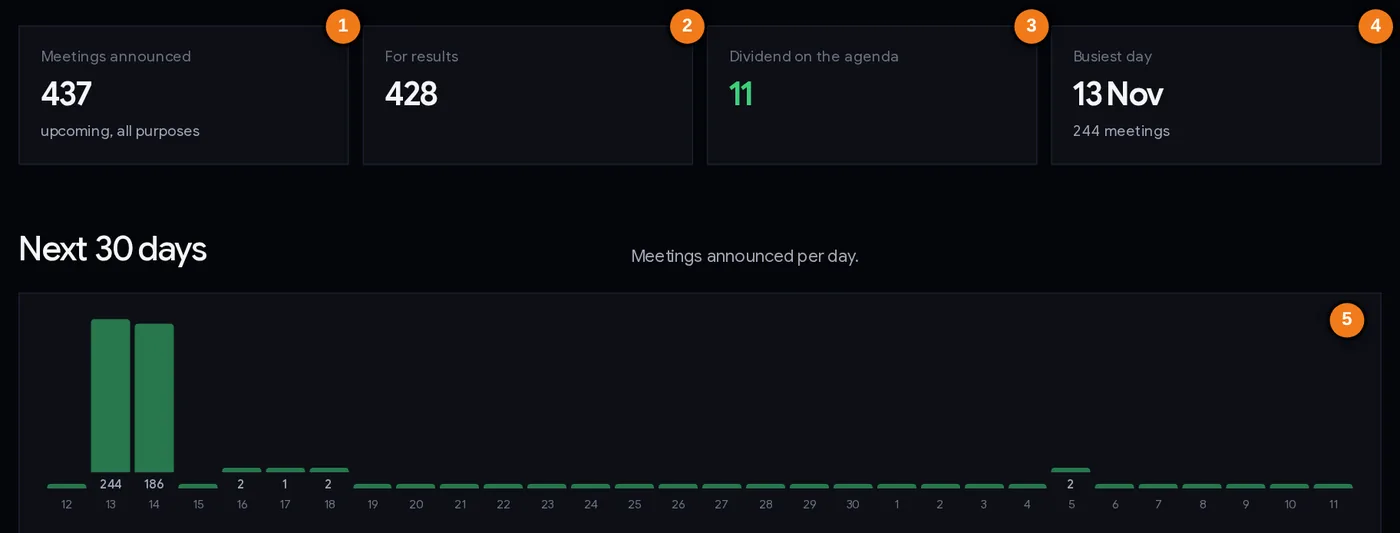
- 1All upcoming meetings announced
- 2Meetings to approve results
- 3Meetings with a dividend on the agenda
- 4The busiest day
- 5Meetings per day for the next 30 days
The bar chart counts meetings per day. On 9 Nov 2026 it showed 25 on Tuesday 10 Nov, 48 on Wednesday 11 Nov, 188 on Thursday 12 Nov, 213 on Friday 13 Nov and 141 on Saturday 14 Nov, then almost nothing. That is the last-days-before-the-deadline rush typical of every results season. Hover over a bar to see its date.
Notice the holiday and the Saturday. 10 Nov 2026 was a market holiday (Diwali Balipratipada) and 14 Nov a Saturday, yet boards still met. Companies can meet and publish on non-trading days; the market reacts on the next trading day. The 141 Saturday results all react on Monday 16 Nov.
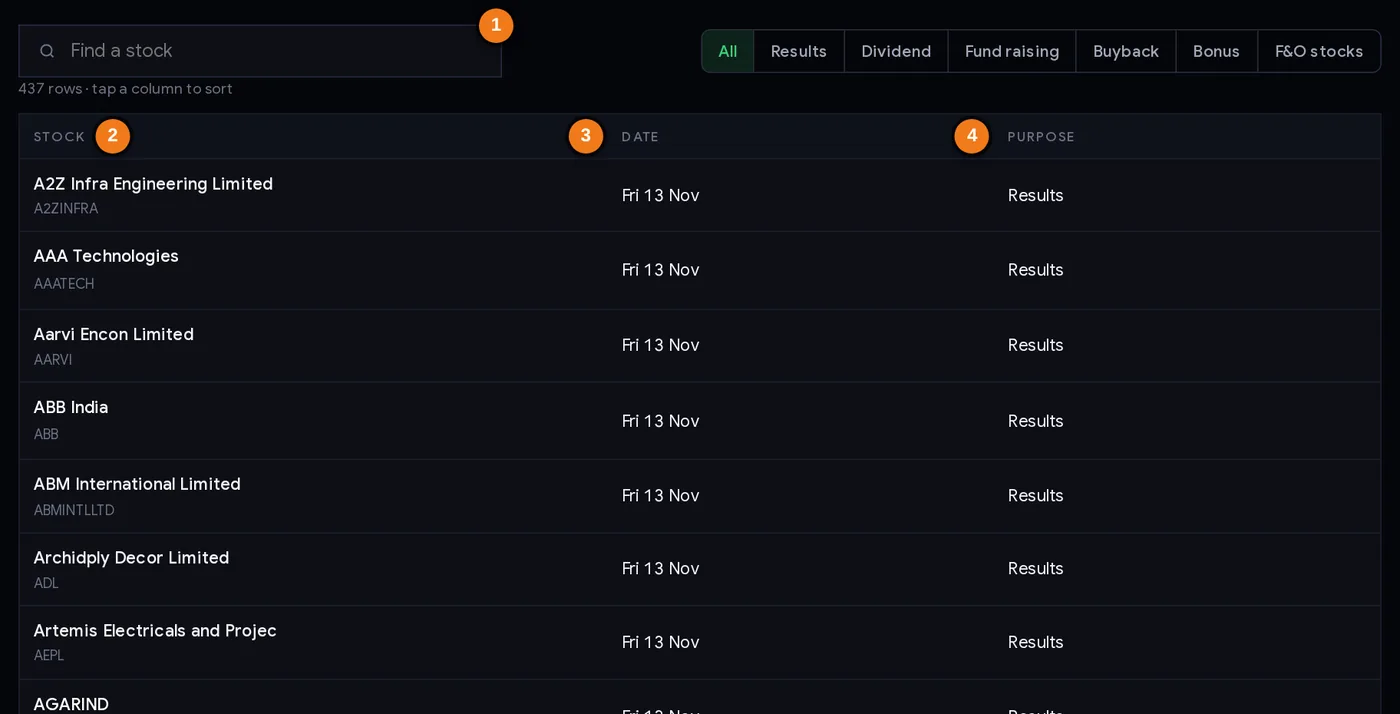
- 1Search box and purpose filters
- 2Company (click for its stock page)
- 3Meeting date
- 4Purpose
| Part | What it does |
|---|---|
| Find a stock | Type a name or symbol to see if it has a meeting coming. |
| All / Results / Dividend / Fund raising / Buyback / Bonus | Show only meetings with that purpose on the agenda. |
| F&O stocks | Only stocks with futures and options (21 meetings on 9 Nov 2026). |
| Stock | Company name and symbol. Click for its stock page. |
| Date | The meeting date. Results usually come out the same day, often after market hours. |
| Purpose | The agenda as filed: Results, Dividend, Fund raising, Buyback, Bonus, Split or Other, combined with “·”. |
Click any column header to sort. The table shows the first rows; Show all at the bottom opens the full list. The questions section at the end of the page answers the common ones, such as which day is busiest.
Step by step: your weekly routine (10 minutes)
- Every weekend, open the calendar and type the symbols of the stocks you own or trade into the search box.
- Note each meeting date and purpose in your diary or watchlist.
- For results meetings of F&O stocks, open the results calendar to see how much the stock usually moves.
- For dividend meetings, expect an ex-date to follow. Watch the corporate actions page for it.
- For bonus, split and buyback meetings, wait for the outcome filing before assuming anything. If approved, the record date and ratio appear on the corporate actions page.
- For fund raising meetings, read the notice: new shares at a discount can weigh on the price.
- Check the busy days on the bar chart and decide whether you want large positions open through them.
- After the meeting, read the results on the quarterly results tracker.
Three playbooks
Playbook A: the portfolio guard (investors)
Once a week, check every holding against the calendar. You are not trying to trade the event; you just want no surprises. If a large holding has results or a fund raising meeting coming, decide in advance whether you are comfortable holding it through, and do not react to the first hour after the news.
Playbook B: the event filter (short-term traders)
Before taking any swing or intraday trade, check whether the stock has a board meeting in the next few days. Many traders simply avoid entering new positions just before results, because the price can gap past any stop loss. If you do hold, cut the size so a gap of twice the stock’s usual results move would still be an acceptable loss.
Playbook C: the corporate action watch
Filter to Dividend, Bonus and Buyback. Note the companies and check their outcome filings after the meeting. Approved actions then appear with their ex-dates on the corporate actions page, where you can see exactly when you need to own the share to qualify.
Remember: buying a share only to get a dividend rarely works, because the price falls by roughly the dividend on the ex-date (see the corporate actions tutorial). Always size positions from your maximum loss with the position size calculator.
Case studies: from board meeting to market
1. The 13 November rush
On 9 Nov 2026 the calendar showed 213 meetings on Friday 13 Nov, 188 on Thursday 12 Nov and 141 on Saturday 14 Nov: 542 meetings in three days, close to the 14 Nov deadline for the July–September quarter. Lesson: the last week of results season is crowded with smaller companies that get little news coverage. If you own small caps, this is the week to check the calendar.
2. Results and dividend: ONGC, NTPC and Dabur
ONGC filed its July–September results on 5 Nov 2026 at 6:36 PM. Its ₹8 interim dividend goes ex on 12 Nov, a yield of 3.45% on the latest close. NTPC filed results on 31 Oct; its ₹3 interim dividend went ex on 6 Nov. Dabur filed on 4 Nov; its ₹3.50 interim dividend went ex on 9 Nov. Lesson: a results-plus-dividend meeting is usually followed by an ex-date about a week later, which you can then find on the corporate actions page.
3. A Saturday meeting: HDFC Bank, July 2026
HDFC Bank’s board approved results on Saturday 18 Jul 2026 and published at 2:22 PM. Nobody could trade until Monday 20 Jul, when the share opened 3.61% lower and closed down 5.12%, against a typical results move of ±2.1%. Lesson: when a board meets on a weekend or holiday, you cannot react until the next session, and a stop loss cannot protect you from the opening gap.
4. Meetings “to consider”: buybacks, bonus and splits
On 9 Nov 2026 the calendar listed Jullundur Motor Agency (Delhi) on 12 Nov “to consider buyback”, T T Limited on 16 Nov for a buyback proposal, and Sheetal Cool Products on 12 Nov “to consider bonus, stock split and other business matters”. Lesson: these notices tell you a decision is due, not what it will be. The terms (price, ratio, record date) come only in the outcome filing.
Common mistakes
- Treating “to consider” as “approved”. Wait for the outcome filing.
- Forgetting non-trading-day meetings. Saturday and holiday results react on the next trading day, often with a gap.
- Holding big F&O positions into results week without checking the calendar.
- Buying for a dividend without knowing the ex-date and that the price drops on that day.
- Ignoring fund raising meetings. A large share sale at a discount can affect the price.
- Using an old date. Meetings get postponed; refresh before acting.
- Skipping “Other business”. It can be routine, or a merger. Read the notice.
Weekly board meeting checklist
- Searched every holding and every stock I plan to trade.
- Noted meeting dates and purposes.
- Checked typical results moves for F&O names on the results calendar.
- Know which meetings fall on a Saturday or holiday.
- Decided in advance what I will do with each position through the event.
- Will wait for the outcome filing before acting on dividend, bonus, split or buyback news.
- Position sizes allow for a gap larger than usual.
Glossary
| Board of directors | The group elected by shareholders to oversee the company and approve major decisions. |
| Intimation | The advance notice of a board meeting filed with the exchange. |
| Outcome | The filing after the meeting that states what was decided. |
| Interim / final dividend | A dividend paid during the year / after the year’s accounts are approved. |
| Record date | The date on which you must be a registered holder to receive a dividend, bonus or buyback entitlement. |
| Ex-date | The first day the share trades without that entitlement. |
| Bonus issue | Free extra shares in a fixed ratio. |
| Stock split | Dividing shares into more shares of lower face value. |
| Buyback | The company buying its own shares from holders. |
| QIP | Qualified institutional placement: selling new shares to large institutions. |
| Trading window | The period in which insiders may trade; it is closed around results. |
Questions
Which companies have board meetings today?
The board meetings calendar lists every NSE company that has announced an upcoming board meeting, by date and purpose. Search for a symbol or filter by results, dividend, fund raising, buyback or bonus.
Why do companies hold board meetings?
To approve decisions that only the board can make: quarterly results, dividends, bonus issues, stock splits, buybacks and fund raising. Listed companies must tell the exchange in advance and publish the outcome afterwards.
Does a board meeting for a bonus mean a bonus is confirmed?
No. A notice “to consider” a bonus, split or buyback only means the board will discuss it. The decision, ratio and record date are confirmed in the outcome filing after the meeting.
How many days before a board meeting must a company inform the exchange?
For results, SEBI’s listing rules require at least two working days’ advance notice, and many companies give more. The calendar shows meetings as soon as they are announced.
Can a board meeting be held on a Saturday or a market holiday?
Yes. On 9 Nov 2026 the calendar listed 25 meetings on the 10 Nov market holiday and 141 on Saturday 14 Nov. The market reacts on the next trading day.